Showing posts with label Cormac McCarthy. Show all posts

Monday, April 22, 2013

Red Sky In Early Evening

If you’re going to be around Dublin city centre next Thursday, April 25th, you could do a lot worse than get along to Dubray Books on Grafton Street at 6.30pm, where Paul Lynch will be launching his debut novel, RED SKY IN MORNING (Quercus).
  Opening in Donegal in 1832, the novel follows land labourer Coll Coyle as he suffers the consequences of a single ill-judged act of rash violence. It’s a compelling tale, not least because of the power of the language, which put me in mind of Cormac McCarthy’s early work. There’s also a kind of epic, cinematic sweep to the events, which shouldn’t really be surprising – Paul Lynch was for many moons the film critic for the Sunday Tribune.
  I know Paul, so you may want to take my opinion with a pinch of salt, but I think RED SKY is a terrific piece of work. I particularly liked the tone, which seems to be pitched somewhere between the bleak fatalism of noir and the Fate-hounded tales of classical Greek tragedy.
  So there it is. RED SKY IN MORNING by Paul Lynch: it’s early days still, but I’d imagine it’ll be hailed as one of the most impressive Irish debuts of the year.

Monday, July 23, 2012

“Ya Wanna Do It Here Or Down The Station, Punk?”: Anthony Quinn

Yep, it’s rubber-hose time, folks: a rapid-fire Q&A for those shifty-looking usual suspects ...

What crime novel would you most like to have written?
Anything by Graham Greene, because his shading of good and evil still resonates strongly today. Has there ever been a better writer of noir?

What fictional character would you most like to have been?
Patrick Kavanagh’s Tarry Flynn - a life spent constructing hayricks and reading poetry in the hedgerows, with a pitchfork to hand for devilment at night.

Who do you read for guilty pleasures?
Social media websites are a terrible distraction when you have writer’s block at the computer. Dickens and Shakespeare were so prolific only because their inkwells weren’t full of friends and followers jostling for their attention.

Most satisfying writing moment?
Successfully forging a doctor’s prescription. No, seriously, when a background character you thought insignificant suddenly takes over a page and then an entire chapter.

The best Irish crime novel is …?
I know this is the golden age of Irish crime fiction with authors such as mine host’s ABSOLUTE ZERO COOL redefining the genre itself, but I think the best Irish crime novel is still out there, lurking in the subconscious, waiting to be written …

What Irish crime novel would make a great movie?
Any of Stuart Neville’s thrillers, which read as vivid cinematic treatments of Northern Ireland.

Worst / best thing about being a writer?
Worst thing is the daily confrontation with a blank page. Best thing is filling same – even though you might feel like flushing it down the loo the next day.

The pitch for your next book is …?
My historical thriller BLOOD DIMMED TIDE is currently doing the rounds. WB Yeats and his assistant ghost-catcher are summonsed to Sligo by the restless spirit of a girl whose body is mysteriously washed ashore in a coffin from the previous century. They are led on a gripping journey through the ruins of Sligo’s abandoned estates and into its darkest, most haunted corners as the country descends into a bloody war of independence.

Who are you reading right now?
Cormac McCarthy’s early ‘Appalachian noir’.

God appears and says you can only write OR read. Which would it be?
I’d pick ‘read’ rather than ‘write’, and hope it’s not an Old Testament God, otherwise he’ll condemn me to an eternity of reading my own work as a just punishment for attempting to get it published.

The three best words to describe your own writing are …?
Everything is practice.

Anthony Quinn’s DISAPPEARED is published by the Mysterious Press.

Wednesday, May 30, 2012

“Ya Wanna Do It Here Or Down The Station, Punk?”: Jeffrey Siger

Yep, it’s rubber-hose time, folks: a rapid-fire Q&A for those shifty-looking usual suspects ...

What crime novel would you most like to have written?
Though one might not think of it as a ‘traditional’ crime novel, I’d have to say BLOOD MERIDIAN by Cormac McCarthy. There’s none better to my way of thinking.

What fictional character would you most like to have been?
No question about it. Sherlock Holmes, original version. Golden Victorian prose and none of that DNA detecting stuff to clutter one’s tiny attic of an investigative mind.

Who do you read for guilty pleasures?
The plays of August Wilson, he’s a master of dialect.

Most satisfying writing moment?
When my new Chief Inspector Andreas Kaldis novel, TARGET: TINOS, received a starred review from Publishers Weekly. Although I’ve received similar reviews for earlier works, TARGET: TINOS was a particularly long haul to complete; indeed I had to write two books to come up with just one. I’d written the first one in 2010 and it was scheduled to come out in January 2012, when out of the blue its central storyline and later my primary bad guy came to life and played out across the world as independent, front-page headline news events. What I’d put forth as an original story line now seemed hopelessly derivative and my publisher and I agreed to kill it. Writing the novel that replaced it was not a pleasant experience … for all the while I had an eye on the headlines, praying events I imagined would not again be overrun by reality. As things turned out they were! But by then I was smiling ear-to-ear for the first reviews were in, calling TARGET: TINOS, “another of Jeffrey Siger’s thoughtful police procedurals set in picturesque but not untroubled Greek locales”—The New York Times, “superb…a winner”—Publishers Weekly, “complex portrait of contemporary Greece to bolster another solid whodunit”—Kirkus Reviews, “fast paced…interesting and highly entertaining”— Library Journal, “throbs with the pulse of Greek culture…an entertaining series”—Booklist.

The best Irish crime novel is …?
Excluding my host’s novels, which must be included at the very top of any such list, and since I’m being pressed to answer, I’ll say IN THE WOODS by Tana French.

Worst / best thing about being a writer?
Worst: you can very easily forget about your obligations to the rest of your life. Best: you can very easily forget about your obligations to the rest of your life.

The pitch for your next book is …?
“Honest, it’s almost done.” Oh, you don’t mean to my editor. Then I’d say: “Life as we know it is changing in the West. Forces of occupation no longer come with armaments, but with pens, promises, and lots of cash.”

Who are you reading right now?
Believe it or not, Samuel Beckett. Just finishing up WAITING FOR GODOT for the zillionth time.

God appears and says you can only write OR read. Which would it be?
Write. Although I think it would be in everyone’s best interest that I be allowed to read my work for editing purposes.

The three best words to describe your own writing are …?
Authoritative, compelling, authentic.

Jeffrey Siger’s TARGET: TINOS is published by the Poisoned Pen Press.

Tuesday, January 24, 2012

The James Gang

I had a round-up of recent crime titles published in the Sunday Independent last week, among them PERFECT PEOPLE by Peter James and DEATH COMES TO PEMBERLEY by PD James. I’ve mentioned both of those titles here recently, though, so here’s the third of the reviews, being FEAST DAY OF FOOLS by James Lee Burke. To wit:
Set in contemporary Texas, FEAST DAY OF FOOLS by James Lee Burke is a very modern novel that is nevertheless obsessed with the past. The novel is the third in a series of books to centre on Hackberry Holland, county sheriff of a Texas territory that shares a border with Mexico; the first in the series, LAY DOWN MY SWORD AND SHIELD, was published in 1971, while the second, RAIN GODS, was published in 2009.
  Here Holland finds himself faced by an old adversary, a religiously-inspired killer called Preacher Jack. He also struggles to cope with a narco-gang spilling over the border from Mexico, led by the ruthless Krill; and a number of competing groups, some of whom are legal, others criminal, who are in pursuit of a missing man called Noie Barnum, an engineer with information on the Predator drone, and who is considered a valuable asset to be captured and sold to Al Qaeda.
  Written in a style that could on occasion be mistaken for that of Cormac McCarthy, Burke’s prose is here heavily influenced by Biblical references, as the aging Holland meditates on this mortality and tries to come to terms with his failings as a man. Holland is depicted as something of a bridge between the past and the future - his grandfather, for example, was an Old West sheriff - and Burke is at pains to set Hackberry Holland very firmly in the landscape of south Texas, frequently writing eloquently descriptive passages about the deserts and mountains, its storms, sunsets and dawns.
  Despite the contemporary references, however, and Burke’s explicit referencing of the consequences of 9/11, FEAST DAY OF FOOLS is no less than a good old-fashioned Western masquerading as a crime thriller, fuelled by the pioneer spirit and the attempt to impose order on the anarchy of the lawless Old West. The result is a hugely entertaining and thought-proving novel.
  This review first appeared in the Sunday Independent.

Sunday, October 23, 2011

“Ya Wanna Do It Here Or Down The Station, Punk?”: Tom Galvin

Yep, it’s rubber-hose time, folks: a rapid-fire Q&A for those shifty-looking usual suspects ...

What crime novel would you most like to have written?
THE POSTMAN ALWAYS RINGS TWICE by James M. Cain. It’s got so many elements that make it such a tragic and emotional read. Of course the lesson is there -- regardless of circumstances, you don’t profit from crime, even crimes of passion. Not that everyone would agree with that, particularly in the current climate. But this is a story that pulls you in so many directions but ultimately breaks your heart. It is a crime story, but a very credible and human one. If a story lacks humanity, somewhere, then it struggles to be told.

What fictional character would you most like to have been?
Where to start . . . lots of fictional characters I love as fictional characters, but then there are characters in fiction that are so vividly portrayed that they sit better in an everyday world. One jumps out, the character Ed in James Dickey’s novel, DELIVERANCE, so brilliantly played Jon Voight in the film. He is the one who rises above the horror of the situation the group find themselves in -- not only against their pursuers, but against the natural elements -- and comes out the cool hero. Although in the book Ed is a balding, pudgy character in his forties somewhere; so I would prefer the Jon Voight version if that’s okay.

Who do you read for guilty pleasures?
My last ‘guilty pleasure’ was Stephen King’s FULL DARK, NO STARS. Why King is classified as a ‘guilty pleasure’ is a mystery to me. As he is one of the greatest story tellers there is and while there were a couple of tales in this collection that disappointed the first, 1922, is one of the darkest and most original stories I’ve read in years. My only other crib here . . . the cover image of the night sky? There were lots of stars on it. Something in that perhaps?

Most satisfying writing moment?
There have been a couple. In terms of actual writing, there was a ‘eureka’ moment in a novel called THE RUSSIAN DOLL, which came to me when I went to a Russian exclave called Kaliningrad to research the book. I needed a strong plot twist and couldn’t come up with one. I spent a fortune getting there and it was the weirdest place I’ve ever visited. But while I was there I got what I needed and finished the book. It’s on the way . . . I hope. In terms of satisfaction as a writer, getting the first copy of GABRIEL’S GATE home. It was almost three in the morning and I was soused and pickled but I sat up and savoured the moment. That book has a long history, a long wait, and I had actually abandoned it a long time ago. So holding a physical copy I thought I would never get to hold was incredible. Of course, the hard work starts now. But at least it gets the ball rolling at a time when I was literally on the verge of dropping out of the game altogether because of so many other commitments.

The best Irish crime novel is …?
Martin Dillon’s THE SHANKHILL BUTCHERS still makes me shudder every time. I normally read a book that grips me several times; but this could only be read once. Of course it wasn’t fiction, so in terms of a novel, I’ll give it to John Banville’s THE BOOK OF EVIDENCE. I was reading a lot of Camus at the time as a student and this sat comfortably with the mood I was in.

What Irish crime novel would make a great movie?
Quite a few now ... but will take a punt on something by Declan Hughes being grabbed soon; maybe Tana French.

Worst / best thing about being a writer?
You’re never satisfied. Even when you reach a goal, you don’t even want to stand long enough to give yourself a round of applause. All you’re thinking is . . . now what will I do?

The pitch for your next book is …?
It’s set in Mexico and concerns a group of travellers on their last trip as a circle of friends who unwittingly become involved in, how should I put it, an ‘existential kidnapping’ in the jungles of the Yucatan. Have I coined a new phrase? Perhaps a new genre?

Who are you reading right now?
Cormac McCarthy’s Border Trilogy; it was on my list for some time as I have read so much of this great man’s work. I began it before revising GABRIEL’S GATE but had to drop it because there was no time. As with all of McCarthy’s books, it kicks, punches, shocks and caresses the soul all in equal measures. Also at my elbow is Arlene Hunt’s new book, THE CHOSEN, and Declan Burke’s ABSOLUTE ZERO COOL. One at a time folks . . .

God appears and says you can only write OR read. Which would it be?
Drink.

The three best words to describe your own writing are …?
Read me please.

Tom Galvin’s GABRIEL’S GATE is published by Book Republic.

Friday, September 16, 2011

“Dante Is Well Served Here, All Around.”

I’m feeling a bit guilty, if I’m honest, about snowing the Three Regular Readers with reviews of ABSOLUTE ZERO COOL. But here’s the thing: I don’t get a book published very often, and as far as I know, this may well be the last book of mine that will ever hit a shelf. So, in part, I kind of owe it to the book to spread the word as far as I can; more importantly, and given that Liberties Press were good enough to take a gamble on publishing it when no other house would touch it with the proverbial barge pole, I definitely owe it to Liberties to parp the trumpets at every opportunity.
  Anyway, the latest review to pop up comes courtesy of Richard L. Pangburn at Little Known Gems, who appears to have given AZC quite a close reading, and particularly in terms of the ‘writer vs his muse’ aspect, in which context he cites Cormac McCarthy, Lawrence Block and Dante. The full review can be found here, with the gist running thusly:
“On its surface it crackles with wit, aphorisms, black one-liners, erudite literary allusions, popular culture references, and frequently surprising wordplay … laced with autobiographical asides and very dark humour involving terrorism, fatherhood, hospitals, the relationship between creation and destruction in parable, and much more … ABSOLUTE ZERO COOL is a literary novel and a darkly humorous work of philosophy. It easily falls into that sub-category of intellectual noir … Dante is well served here, all around.” - Little Known Gems
  All of which is very nice indeed, and I thank you kindly, sir.
  Meanwhile, Tony Bailie of the Irish News published an interview with yours truly yesterday. Here’s a sampler:
Declan Burke’s surreal take on the noir genre is generating rave reviews – including thumbs up from John Banville, Ken Bruen, John Connolly and Colin Bateman – and the character-confronting-the-author twist has seen Burke being compared to Flann O’Brien.
  “I’m a big fan of Flann O’Brien, and particularly AT SWIM-TWO-BIRDS – I’ve always loved that idea of messing about with the way you can tell a story and especially the idea that the characters in a book are entitled to have their say about how the story is going,” Burke says.
  “You can get a bit heavy about it and talk about how it’s an expression of free will, with the writer being ‘God’ and the characters ‘human beings’ – I mean, if your life is a story, don’t you feel like you’re entitled to have some say in how it‘ll work out?
  “I didn’t sit down and say, ‘Right, I’m going to write a Flann O’Brien book.’ The way the story came out is the way it needed to be to tell this particular story. Besides, that kind of narrative playfulness is far older than Flann O’Brien. It’s nearly as old as the novel itself, going all the way back to Tristram Shandy.”
  For the rest, courtesy of Tony Bailie’s blog (the Irish News being a subscription site), clickety-click here

Saturday, June 18, 2011

“Ya Wanna Do It Here Or Down The Station, Punk?”: Thomas Fitzsimmons

Yep, it’s rubber-hose time, folks: a rapid-fire Q&A for those shifty-looking usual suspects ...

What crime novel would you most like to have written?
Not an easy question, Declan. What with all the terrific authors out there. But if I have to make a choice, it would be between—starting with contemporary American authors—John D. McDonald’s DARKER THAN AMBER, Ed McBain’s MARY, MARY, Nelson Demille’s LION’S GAME, Robert B. Parker’s SMALL VICES, and Elmore Leonard’s GET SHORTY. As for Irish writers, I’d go with Tana French’s IN THE WOODS, Adrian McKinty’s DEAD I WELL MAY BE, Ken Bruen’s THE GUARDS.

What fictional character would you most like to have been?
Humm. I have to admit there is no fictional character I’d like to have been, because I’ve lived the life that most crime and thriller authors write about. I was raised by good Irish parents—Cavan people. I was a New York City cop, an actor (a really lousy actor), a model and a TV spokesperson. Now, I serve as a bodyguard for A-list actors and write in my free time. I live in the heart of NYC, surrounded by friends and family (and great pubs) and have been blessed, so far, with good health. I wouldn’t trade places with anyone —real or fictional.

Who do you read for guilty pleasures?
Guilty pleasures are ALL I read these days. There was a time when I’d force myself to finish any book I started. Now if I can’t relate to the characters or story in about 25 pages, I put the book down. Who do I pick up first? Robert B. Parker.

Most satisfying writing moment?
When Truman Capote read a short story of mine, told me I had a future as a writer, and then introduced me to his agent. I was too young to appreciate it at the time—my only interest then being women and beer—but looking back … wow. Reading good reviews of my book on Amazon.com also makes me feel good.

The best Irish crime novel is …?
Heck if I know. There’re simply too many good books too choose from.

What Irish crime novel would make a great movie?
Because I like to laugh, I’ll go with MYSTERY MAN by Colin Bateman, and your own THE BIG O. There are plenty of laughs in both books that I think would convert well to film.

Worst / best thing about being a writer?
In my experience, the worst thing about being a writer is dealing with publishers. I’m fully convinced that, like Stephen King says, “No one in publishing has any idea what they’re doing.” When my publisher Tor/Forge published CITY OF FIRE, they published another book by the same title, with a similar theme, and similar cover art, at the same time. When I objected, the publisher insisted that having the two thrillers, in the same mystery/thriller sections in book stores at the same time, wouldn’t be a problem. They, of course, were dead wrong. There’s also the fact that an author has to deal with the publisher’s totally overworked and grossly underpaid editors, marketing, and public relations people. The BEST thing about writing is getting to write every day. And when a book is really ‘clicking’ I can feel it; it’s euphoric. I know you know what I mean.

The pitch for your next book is …?
CONFESSIONS OF A SUICIDAL POLICEWOMAN is the second in the Michael Beckett series. It focuses on police officers Michael Beckett and Destiny Jones, two characters I introduced in CONFESSIONS OF A CATHOLIC COP. Beckett is the suave but tough protagonist, who battles a powerful NYC real estate mogul in book one. In CONFESSIONS OF A SUICIDAL POLICEWOMAN, Beckett and Jones, now partners in the NYPD, are starting to come to terms with their true feelings for one another when their world suddenly shifts gears. An ex-cop recruits Beckett into his gang of “rockers,” a secret society of vigilante cops who protect businesses from shakedowns—for a price. A violent drug ring has taken control of an Upper East Side hotel. The ring needs to be cleaned out and an old girlfriend of Beckett’s, an amoral tart who happens to co-own the place, needs saving. This leads Beckett and Jones into one of the deadliest, most tangled operations of their lives, as he pursues the drug kingpin who killed his baby sister, and Jones suffers a horrible injury, leaving her to confront life as an invalid or a death with dignity by her own hand.

Who are you reading right now?
I read several books at once. Currently I’m reading Lisa Garner, Cormac McCarthy, and James Lee Burke. I just finished Walter Mosley’s THE LAST DAYS OF PTOLEMY GRAY and re-read Ian Fleming’s THUNDERBALL.

God appears and says you can only write OR read. Which would it be?
Since one can’t write without first being an avid reader, I’d have to slap God upside the head and say, “WTF?”

The three best words to describe your own writing are …?
Minimalist. Gritty. Fun.

Thomas Fitzsimmons’ CONFESSIONS OF A CATHOLIC COP is available in paperback and e-book.

Saturday, April 30, 2011

“Ya Wanna Do It Here Or Down The Station, Punk?”: Bill Loehfelm

Yep, it’s rubber-hose time, folks: a rapid-fire Q&A for those shifty-looking usual suspects ...

What crime novel would you most like to have written?
That’s a tough one; there are a lot to choose from. NO COUNTRY FOR OLD MEN by Cormac McCarthy is one, for sure. It approaches the level of American mythology, the way it examines evil, greed, and violence. Also, CASE HISTORIES by Kate Atkinson, simply because it’s so utterly brilliant and gut-wrenching from the first word. Those two and a lesser-known book called CHEAP TICKET TO HEAVEN by Charlie Smith, about a bank robbing couple on the run through the US. It’s surreal, dark, philosophical, and one of the most unique novels I’ve ever read, crime or not. If I had to pick one, I’d say CHEAP TICKET, because it pushes the limits of the crime novel the furthest.

What fictional character would you most like to have been?
This one is easy. Batman. Not that I don’t love my parents, but the ability to kick that much ass on people who really deserve it is pretty tempting. Plus, there’s Catwoman.

Who do you read for guilty pleasures?
I like sports writing about baseball. In another life, if I couldn’t play the game, I’d be a beat writer for the New York Mets.

Most satisfying writing moment?
That live moment when it’s really flowing and you know it’s good. That fleeting, ephemeral high is the best, when you’re free from wondering about the final result of it. Also, I have to say, sending a manuscript to my editor or my agent – knowing it doesn’t have to be letter perfect to impress and that I don’t have write three dozen friggin’ query letters—that’s pretty damn satisfying.

The best Irish crime novel is …?
Can I put a vote in for Roddy Doyle’s THE WOMAN WHO WALKED INTO DOORS? There’s a mysterious death and plenty of bad behavior. Maybe not the best, but certainly most underrated, at least in the States. Everyone knows the Barrytown trilogy, but I think the Paula Spencer novels are brilliant.

What Irish crime novel would make a great movie?
CHRISTINE FALLS by Benjamin Black. Very noir. Intriguing story with all kinds of twists, and I think that era in Dublin would make such a compelling setting. The way Black renders it reminds me of Chandler’s L.A. I’d imagine, after the way Dublin’s changed over the past couple of decades, that those days in Dublin seem even further back and more foreign than ever. Might be fun to look closely at them.

Worst / best thing about being a writer?
Being your own boss. That’s the best and the worst of it. Making all my own hours. In a way, I never have to go to work, but in another way I’m never not at work, either. So I’ve never got nothing to do, but – I never have nothing to do.

The pitch for your next book is …?
A world-weary NYC cocktail waitress sees something she shouldn’t after work one night, putting her and her mother on the wrong side of some very bad people.

Who are you reading right now?
Right now, I’m getting towards the end of Kate Atkinson’s STARTED EARLY, TOOK MY DOG. I’ve got Walter Mosley’s second Leonid Magill novel and a debut novel called LEARNING TO SWIM by Sara J Henry on my TBR pile.

God appears and says you can only write OR read. Which would it be?
Maybe this is a cop-out, but having published a couple of books already, I’d have to choose read. Not that I don’t feel I have plenty more books in me, but not as many as I would miss if I couldn’t read.

The three best words to describe your own writing are …?
Sharp, authoritative, efficient. (I hope)

Bill Loehfelm’s THE DEVIL SHE KNOWS is published by Farar, Straus and Giroux

Thursday, March 3, 2011

Nobody Move, This Is A Review: The Irish Times’ Crime Beat # 2,037

Being the latest in yours truly’s crime fiction round-ups for The Newspaper Formerly Known as the Old Lady of D’Olier Street. To wit:

Urban Waite’s THE TERROR OF LIVING (Simon & Schuster, £12.99, pb) derives its momentum from the intersecting arcs of three men: Bobby Drake, a deputy in Washington State, who stumbles across a drug-smuggling operation high in the mountains on the US-Canadian border; Phil Hunt, an ex-convict who subsidises his small-time ranching with an occasional trip across the border muling heroin; and Grady Fisher, a psychotic killer detailed to retrieve the missing heroin and murder anyone who might implicate his employers. Those broad strokes run perilously close to the plot of NO COUNTRY FOR OLD MEN (2005), and largely accounts for the comparison to Cormac McCarthy in the novel’s blurb. While THE TERROR OF LIVING lacks McCarthy’s lyricism, the writing is pleasingly spare, muscular and lean, the characters sharply and for the most part sympathetically drawn, and the narrative a compelling blend of breathless plotting and existential angst. Beautifully descriptive in capturing the details of Seattle’s rural hinterland, THE TERROR OF LIVING is a remarkably assured debut.
  Louise Penny’s sixth novel, BURY YOUR DEAD (Sphere, £7.99, pb), is something of a curio, and not just for its Quebec setting. Featuring Penny’s recurring series protagonist, Chief Inspector Armand Gamache of the Sûreté, the novel is comprised of three distinct investigations, with Gamache, off-duty and recuperating after an operation went disastrously wrong, surreptitiously investigating the murder of a Quebecois historian who was obsessed with Samuel de Champlain, the legendary founder of Quebec City. Most intriguing, however, is the narrative strand in which Gamache, second-guessing his own investigation in Penny’s previous novel, THE BRUTAL TELLING (2009), sends his second-in-command, Beauvoir, to the bucolic village of Three Pines to unofficially re-open the case. Penny’s interweaving of her various strands is ambitious, and there’s much to enjoy in her affectionate and elegant descriptions of Quebecois foibles and the bitter Canadian winter. That said, first-time readers might find themselves confused by Penny’s rewriting of a previous novel’s plot, and there are times when the story reads like a too fervent homage to Agatha Christie, not least in the finale when not one but two groups of suspects are brought together to hear a detective announce the identity of a murderer.
  Peter Leonard’s ALL HE SAW WAS THE GIRL (Faber and Faber, £12.99, pb) also reads like something of a homage, in this case to Elmore Leonard, Peter Leonard’s father. American student McCabe gets kidnapped in a case of mistaken identity in Rome; once released, McCabe sets about retrieving the ransom from the Mafia-connected gang who kidnapped him. A multi-character narrative incorporates Angela, a Mafia don’s daughter, flamboyant Detroit mobster Joey Palermo, ex-Secret Service agent Ray, and Sharon, Ray’s wife and Joey Palermo’s current squeeze. The various narrative arcs converge on Rome and its rural hinterland, both of which Leonard is adept at evoking despite his pared-down style and use of the American vernacular. A bright and breezy comedy crime caper, albeit one which boasts a deadpan tone and blackly comic touches, the story moves at a furious rate as the characters ricochet around Rome. It’s all highly entertaining even if, in the most odious comparison possible, the novel lacks the heft of an Elmore Leonard novel, particularly in terms of the absence of any sense of real menace from the gangsters McCabe and Ray encounter.
  The killer whose murder propels Laura Wilson’s A CAPITAL CRIME (Quercus, £12.99, pb) also lacks menace, although given that Wilson has based her novel on a true crime that occurred in post-WWII London, and that the murderer is a pathetically child-like creature, the novel is all the more fascinating for its absence. The third novel to feature Wilson’s DI Stratton, after STRATTON’S WAR (2008) and AN EMPTY DEATH (2010), the novel opens with Stratton charged with assembling the evidence that will reinforce John Davies’ confession that he strangled his wife and baby daughter. Satisfied that the facts mostly add up, Stratton sees Davies hanged, but subsequently comes to suspect a miscarriage of justice. Meticulously researched, A CAPITAL CRIME is suffused with an almost claustrophobic sense of post-war London, a city still suffering from the impact of rationing and only reluctantly coming to terms with the decline of Britain’s empire. Stratton himself is an immensely likeable character, an amiable and morally upright policeman who is only too aware of his own flaws. Wilson neatly contrasts Stratton’s ongoing mourning for his dead wife with his daughter’s dawning awareness of her lesbian sexuality, blending the personal with the more political aspects of Stratton’s professional self-doubt in a very satisfying historical police procedural.
  Set in rural Mississippi, Tom Franklin’s CROOKED LETTER, CROOKED LETTER (Macmillan, £11.99, pb) opens with the shooting of small town mechanic Larry Ott, a semi-recluse who has long been suspected of the abduction and murder of a local girl some decades before. Local deputy Silas Jones is reluctant to lead the investigation into the shooting, as he and Larry were childhood friends before an ugly racial incident drove them apart, but the disappearance of another young girl overrules Silas’s personal distaste for the case. Ostensibly a police procedural, Franklin’s third novel deploys the genre’s narrative conventions as a framework for a much deeper exploration of the psychology of small-town America and its recent racist past. Both Larry and Silas are superbly drawn and fully fleshed characters, their personalities and conflict chthonic to rural Mississippi but luminously relevant, in Franklin’s hands, to any locale on the planet. Factor in a mesmerising evocation of rural Mississippi, language of sinuous and shimmering elegance, and a finely tuned ear for the nuances of dialogue, and you have a novel that is an early contender for one of the great novels of the year. - Declan Burke

  This article was first published in The Irish Times

Sunday, January 9, 2011

Burke On Burke; Or, Why Some Writers Are Too Good To Read

Many, many moons ago, when I was still young enough to read without prejudice or expectation, I picked up a book called ‘The James Lee Burke Collection’. I was poor then, or a little poorer than I am now, and three novels in one book represented value for money that was impossible to resist, especially as I was browsing in a second-hand bookstore at the time. The collection comprised TO THE BRIGHT AND SHINING SUN, LAY DOWN MY SWORD AND SHIELD, and THE LOST GET-BACK BOOGIE.
  If you’re a James Lee Burke fan, you don’t need me to tell you that the collection, even if I’d paid a hundred quid for it, would have been good value for money. Even the cover was fabulous, featuring a moody, sepia-toned black-and-white shot of a wrecked and gun-shot car abandoned on desert flats, a dark and stormy sky brewing overhead. As for the novels themselves, well, you could have substituted the car on the cover for any of the protagonists. Men gnarled and worn down, sand-blasted by lives lived too hard on the edge of nowhere. When I think of those novels now I think of Cormac McCarthy’s border trilogy, of Richard Ford’s THE ULTIMATE GOOD LUCK, of Raymond Carver and Hemingway’s TRUE AT FIRST LIGHT.
  That’s not to suggest that James Lee Burke is a writer on a par with literary giants such as McCarthy, Carver, Ford and Hemingway, or trying to sneak Burke, who is marketed as a crime writer, into the literary pantheon through the back door. I’m saying, definitively and brooking no argument, that James Lee Burke writes novels so good that he’s entitled to have the likes of McCarthy, Carver et al compared (favourably) to James Lee Burke, and I can only pity anyone who is so blinkered as to be blind to that fact.
  The first time I walked into a bookstore after EIGHTBALL BOOGIE was published (a fine emporium in Galway called Charlie Byrne’s, as it happens), said tome was nestling on the shelf beside those of James Lee Burke. Even at the time, high on the improbability of it all, I didn’t kid myself that EIGHTBALL deserved to be in the same shop, let alone on the same shelf; still, it was nice to see it there, if only for the incongruity. Even now, looking at the copy of The James Lee Burke Collection I’ve fished down off the shelf, I’m getting a shiver of anticipation at re-reading those novels yet again at some distant point in the future.
  So how come I’ve never read a Dave Robicheaux novel? Well, it’s complicated. Partly it’s to do with the sheer volume of Robicheaux novels (18 at the last count) and no longer having the kind of reading time that would allow me dive in with THE NEON RAIN and work my way forward; but mainly it’s because the writer part of my brain (tender, fragile, endlessly prone to self-doubt) understands that repeated exposure to James Lee Burke does very little to promote confidence in a writer. To read one great novel is one thing, and there are few pleasures to beat accidentally stumbling across a terrific novel; and nothing pleases me more, when I do discover a great novel, than to be in a position to trumpet the good news from the rooftops. But to willingly subject myself to repeated excellence such as James Lee Burke offers? At least Cormac McCarthy has the good grace to publish a novel only once every five or six years, or more; and Hemingway and Carver had the good grace to die, and so on; but Burke does it year after year after year.
  I do look forward to that distant point in the future, when the kids are reared and my fortune made, and I’m sitting on the balcony of my pension on a remote Greek island, a pomegranate sun sinking into the bottle-green sea, and reaching up to the bookshelf for THE NEON RAIN. Until then, though, I think James Lee Burke will have to wait, even if the signed copy of THE GLASS RAINBOW I received from Irish crime fiction’s most dedicated friend, Noo Yoik’s Joe Long, sits temptingly on a shelf within easy reach …
  All of which is a roundabout way of pointing you towards a rather fine piece the Dark Lord John Connolly published at his interweb lair, which is the introduction he wrote to a new and limited edition of THE GLASS RAINBOW published by Scorpion Press. To wit:
“For many of my generation of mystery writers, James Lee Burke is the greatest living author in our field, and one of the most accomplished literary stylists in modern American letters. For better or worse, I would not be writing without his influence, and all that I have written, I have written in his shadow. To borrow a phrase used by Jack Nicholson of Marlon Brando: “When he dies, everybody else moves up one.”
  “Burke’s preeminence is due, in no small part, to the manner in which he came to the mystery novel. Before publishing, in 1987, The Neon Rain, the first book to feature the recurring character of Dave Robicheaux, he had read little in the genre, the work of Raymond Chandler and James Crumley apart, so he approached the task of writing a mystery largely freed from any obligation to the perceived requisites. The books that have emerged in the decades since are, in a sense, only incidentally mysteries: they are, first and foremost, literate, literary, socially engaged novels. To read them is to encounter a great novelist applying his gifts to a sometimes underrated form, reinventing and reinvigorating it by his presence …”
  For the rest, clickety-click here

Sunday, October 24, 2010

The Gospel According To James

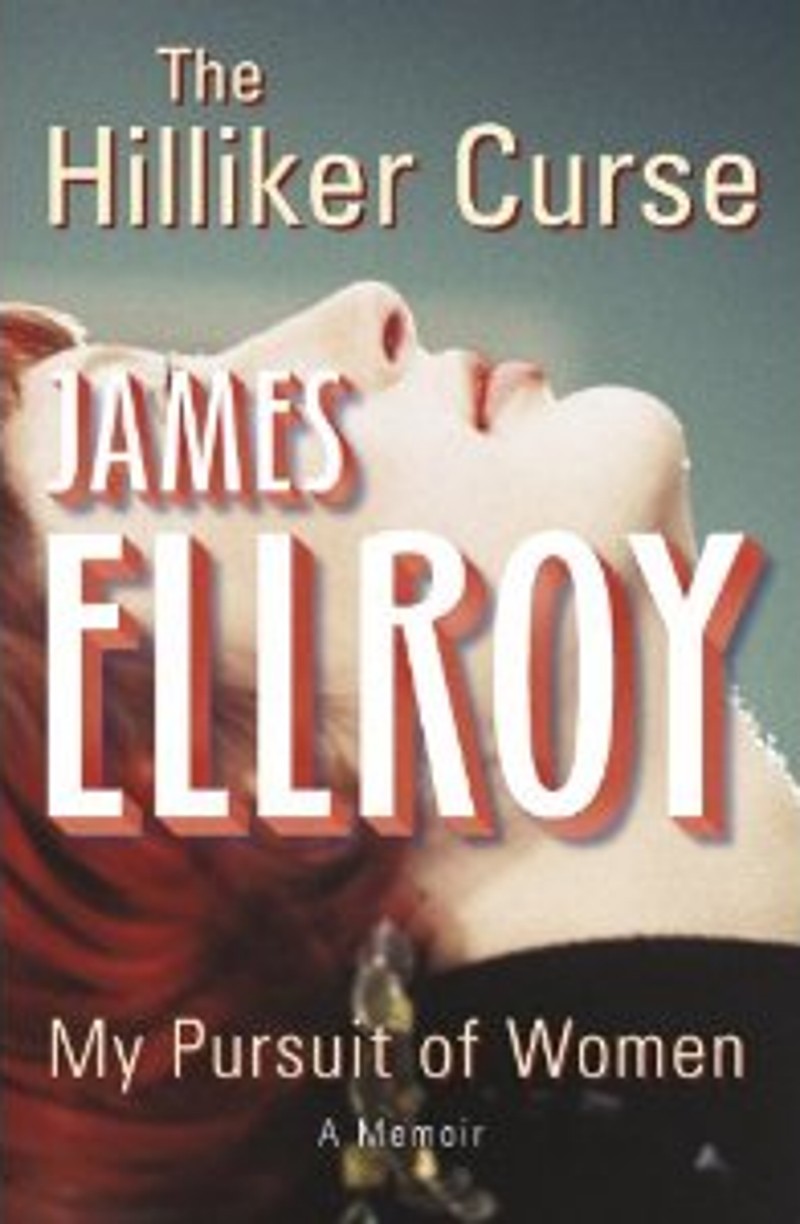
James Ellroy (right) was in town a couple of weeks ago, promoting THE HILLIKER CURSE, and the Evening Herald very kindly sent me along to interview him. The result went a lot like this:
May 28, ’04. Sacramento on a spring heat wave. The six thousandth public performance of my dead-mother act … A man called me glib. I brusquely rebuked him. I said she was my mother - not his. I said I’d paid the price - and he hadn’t.” - James Ellroy, The Hilliker Curse
First, the facts: James Ellroy’s mother, Geneva ‘Jean’ Hilliker, was murdered in 1958, when Ellroy was ten years old. Her killer was never caught. The boy ran wild, stalked women, broke into their houses to peep and prowl. Drug and booze addictions followed. He published his first novel, Brown’s Requiem, in 1981. Twelve more followed, including his breakout novel LA Confidential (1990) and the ‘Underworld’ trilogy of American Tabloid (1995), The Cold Six Thousand (2001) and Blood’s a Rover (2009), all of them riffing on a theme of brutal men avenging vulnerable women.
  Ellroy also wrote My Dark Places (1996), a memoir of the time he spent unsuccessfully investigating his mother’s death. The novel The Black Dahlia (1987), inspired by the true-life murder of actress Betty Short, was dedicated ‘in blood’ to the memory of Geneva Hilliker.
  The charge of exploiting his murder’s death is not one that Ellroy shies away from in his second memoir, The Hilliker Curse: My Pursuit of Women. When his then wife Helen Knode presented him with a photograph of himself taken in the immediate wake of his mother’s death, and asked him what he was thinking, Ellroy replied with a succinctly cold one-word answer: ‘Opportunity.’
  “Yeah, opportunity,” he says, easing back into the plush couch. Cue-ball bald, wild of eye, he is not in the least bit self-conscious about dissecting his mother’s murder amid the muted conversations of The Westbury’s lobby, where we meet shortly after Ellroy walked out on an interview with Today FM’s Matt Cooper after a short but robust exchange. “In Blood’s A Rover, Joan tells [the young, Ellroy-esque voyeur] Don Crutchfield, ‘Your options are do everything or do nothing.’ With my mother, my options are do everything or do nothing. I have decided to do everything. It’s who I am. I’m a pro-active, assertive kind of man, and it wasn’t until I realised that my mother and I comprised more of a love story than a death-and-murder story that I was able to conceive this book.”
  But hadn’t he already covered that ground in My Dark Places?
  “Well, I realised that I had earned - as arrogant as this sounds - the universal significance necessary to write a viable memoir, which has to be about something bigger than you, or you’re full of fucking shit. Misogynistic violence in My Dark Places versus the conjunction of men and women in The Hilliker Curse. I realised this book could be something I’ve never done before, which is an autobiographical essay. By that I mean this: I get to be the younger Ellroy describing his crazy shit, and the older, more mature Ellroy commenting editorially upon it.”
  The younger man, as Ellroy documents in forensic detail, was tortured by self-conjured demons. All things considered, would that younger Ellroy think that the older man had burned up those demons in laying the ‘Hilliker curse’ to rest?
  “Yes. I put those demons to very, very good use. What I say in the book is that the fount of my will was and is the ability to exploit misfortune. And I could write about my mother or ignore my mother, I could tell my mother’s story, I could address it once, reinterpret it a second time … I had options. And I think I chose the right one.”
  In terms of style, The Hilliker Curse is less frenzied than Ellroy’s recent fiction.
  “I am giving the reader a helping hand,” he says. “I am giving the reader more emotional breathing room, more rumination. It all comes back to the two Ellroy motifs - the immediacy of the physical description, when I’m younger or in early middle age, and the rumination. You get the highfaluting riff and you get the fuck-shit-fuck-motherfucker stuff interchangeably, and it works. It works here because it is the voice of a dying breed of man. I think that a lot of the mixed reviews in America to date are because it’s written in such a blunt, heterosexual, white male language. And there’s another issue that attends this, which is that it’s not the least ironic. It’s romantic. This book says There Is Someone Out There - Find Her. Go To Any Lengths. Whatever It Costs. Whatever It Takes.”
  The ‘Her’ is Erika Schickel, Ellroy’s current partner, and who is in the process of leaving her husband for the writer. “I reject this woman as anything less than God’s greatest gift to me,” he writes near the end of The Hilliker Curse. “She is an alchemist’s casting of Jean Hilliker and something much more. She commands me to step out of the dark and into the light.”
  “The thing that’s bothered me about the critical reception so far,” says Ellroy “is that people find it a sleazy book. In fact it’s a tender book, and Erika and I are real. I wrote the relationship up to where we were when I had to turn the book in for publication, so I guess people are allowed to be sceptical, given the empirical evidence of my bad behaviour that precedes it. But Erika and I will flourish. I know we’re going to last.”
  Is he happy?
  “I’m happy. And I’ve been happy for a long time because I go out and take a bite out of the world, and I kick the shit out of the world, and I express my emotions, tell Matt Cooper to fuck off …”
  So what’s next for James Ellroy?
  “I’m going to write bigger, more romantic books. I will not be coy, I will tell you for attribution what I’m doing next. I am going to write a second LA Quartet. I am taking characters from the first Quartet - The Black Dahlia, The Big Nowhere, LA Confidential and White Jazz - and the Trilogy - American Tabloid, The Cold Six Thousand and Blood’s A Rover - and placing them in LA during the month of Pearl Harbour as much younger people. World War II will also be a character in the book, and it’s that month, of Pearl Harbour in December 1941, in real time.”

  The Hilliker Curse: My Pursuit of Women by James Ellroy is published by William Heinemann (hb, 224pp, £16.99)

Sidebar: James Ellroy on …

God
“I’m rarely asked about it, but it’s in the novels that I’m a Christian. The men who learn self-sacrifice later rather than earlier, who make the big gesture so that others may live. Atonement, redemption - it’s always been there.”

Jonathan Franzen
“Jonathan Franzen - he’s so full of shit. He pulls this crap on his British publisher, with the typos, they have to pulp 80,000 books, it costs them a quarter of a million pounds? Fuck Jonathan Franzen.”

Beethoven
“I first heard Beethoven in 1960, some fifty years ago, and I flipped out. I love the Romantic composers, Beethoven most of all. He’s been a constant companion of mine all my life. He has in many ways provided the soundtrack for my life with women.”

Cormac McCarthy
“Cormac McCarthy is a stunning American original, he deserves the Nobel Prize for Literature. But he won’t win it, for four reasons: he’s male, he’s white, American and presumably heterosexual … I got pissed off, when I tried to read The Crossing, at the twelve or fourteen pages of Mexican Spanish. What the fuck? My name’s not Juan Ellroy.”

This feature first appeared in the Evening Herald

Monday, May 17, 2010

“Ya Wanna Do It Here Or Down The Station, Punk?”: Michael Harvey

Yep, it’s rubber-hose time, folks: a rapid-fire Q&A for those shifty-looking usual suspects ...

What crime novel would you most like to have written?
Hmm ... I can think of three and can’t pick between them. THE LONG GOODBYE, THE GREAT GATSBY, THE SUN ALSO RISES.

What fictional character would you most like to have been?
Sam Spade ... is there any other answer?

Who do you read for guilty pleasures?
Clive Cussler, Eric Ambler, Homer.

Most satisfying writing moment?
Chapter 41 of THE CHICAGO WAY. Not sure if it’s my favourite passage, but I remember writing it and feeling it in my bones.

The best Irish crime novel is …?
RESURRECTION MEN by Ian Rankin. Scottish, but close enough. (BTW, don’t say that too loud in Glasgow.)

What Irish crime novel would make a great movie?
RESURRECTION MEN by Ian Rankin.

Worst / best thing about being a writer?
The best thing is that it’s just you and your characters. The worst thing is that it’s just you and your characters. Make sense? It’s not supposed to. The bottom line is that writing a novel is one of the purest human endeavours anyone can undertake. It uses up no natural resources and creates something out of nothing. Not magic ... hard work ... but pretty damn cool.

The pitch for your next book is …?
A sequel to THE THIRD RAIL. It starts up a week after THE THIRD RAIL ends and all hell breaks loose.

Who are you reading right now?
Got a few going. Cormac McCarthy, Albert Camus, Aeschylus, Alan Furst and Daniel Silva.

God appears and says you can only write OR read. Which would it be?
Yikes ... I’m Irish Catholic. We don’t like to tempt fate and we don’t like these questions. If I were still a child, I’d say read. Right now, I guess I’d say write.

The three best words to describe your own writing are …?
Physical, cinematic, honest.

Michael Harvey’s THE THIRD RAIL is published by Knopf.

Tuesday, March 16, 2010

What Would Ray Chandler Do?

Last year, over coffee, a good friend of mine asked if I’d be interested in joining a book club, which request sent hot frothy milk spurting from my nose. No thanks, says I, as politely as you can after showering a lady friend in second-hand latte, I’m afraid I have trouble finding the time to read the books I already need to read without adding another to the list on a monthly basis. I also mumbled something about being a bloke, and not wanting my testosterone throwing its weight around the room. What I didn’t say is that my wife is in a book club, and most of the titles she brings home seem to reek of the most irritating kind of smug, middle-class respectability, which probably says a lot more about me than about the books in question.
  Anyway, the Irish bookseller chain Eason recently published their ‘Best Books of the Noughties’ Top 50, which list was voted on by the public in a poll conducted by the on-line Eason Book Club, and it’s mildly dispiriting but not entirely surprising to find that THE GIRL WITH THE DRAGON TATTOO and WHEN WILL THERE BE GOOD NEWS? are the only crime titles therein, unless you want to stretch the boundaries and include NO COUNTRY FOR OLD MEN and THE WHITE TIGER. Given the week that’s in it, it’s disappointing that the list featured no Irish crime writers at all, and this for a decade in which Irish crime fiction exploded onto the bookshelves, in a poll of Irish readers conducted by an Irish bookseller. Depressing stuff, although I’m not necessarily blaming anyone, because the list seems to be made up of the kind of stuff people are directed towards today, including a lot of Booker Prize nominees / winners, and the usual kind of Book Club bait you find in such company. That said, there’s some cracking novels there too – a couple of Banvilles, David Mitchell’s CLOUD ATLAS, two Cormac McCarthys, Sebastian Barry’s A LONG, LONG WAY, the Dark Materials trilogy, a Margaret Atwood, a John McGahern …
  So what’s my beef? Well, I’m just wondering where the crime titles are. It’s either true that crime fiction is hugely popular or it’s not; and if it is, how come it never shows up on such lists? Is it the case that people tend to vote for the kind of thing they think they should be voting for, rather than what they like, and actually read? Were – just for random example – SHANTARAM, THE RELUCTANT FUNDAMENTALIST and I’M NOT SCARED really three of the fifty best novels of the last decade, or are they simply three of the novels people had shoved under their noses by a combination of booksellers, broadsheets and the arbiters of public taste? Or is the list simply skewed towards the conventional kind of Book Club book because it’s a Book Club list?
  Yet more questions: does my antipathy to Book Clubs stem from the fact that I write books that are highly unlikely to feature on Book Club lists, even if I could get them published? Am I, in fact, a scruffy urchin shivering in the snow with my nose pressed up against the drawing-room windows, craving the warm glow of smug middle-class respectability?
  I should say at this point, if you haven’t already guessed, that I’ve gone bi-polar about writing, mainly due to the pointlessness of the exercise. And it’s not just an up-and-down experience – it’s the kind of bi-polar in which you’re up and down at the same time, which makes for an interesting tone in the piece I’m working on at the moment. I have a guy who’s going through the Beckett thing of ‘I can’t go on, I’ll go on’, a kind of passive acceptance of his need for momentum, even as he concedes that his best efforts are a waste of time. He has his own reasons for not wanting to engage with the rest of the characters, and that’s fair enough, but I’m very much afraid that he’s as likely to just throw himself off the ferry he’s on right now as do something constructive, or destructive, or at least do something that’s interesting to potential readers. Maybe it’s the paralysing stasis that’s affecting Ireland right now, as it grinds to an economic halt with precious little direction from those responsible for such things, but there’s every chance the chap in the story will just down tools and call a sit-in protest on the top deck of the ferry, a kind of one-man campaign of civil disobedience against being forced to jump through hoops on behalf of an audience that simply doesn’t exist. What would Chandler do? He’d have a drink, and send a guy through a door with a gun already in his hand … but sometimes even that, or Chandler, isn’t enough to get the blood stirring.
  Incidentally, my wife’s Book Club is this month reading FOR WHOM THE BELL TOLLS, on the basis that one of the ladies decided it was high time for some proper reading. Good for her.

  Recently I have been reading: IF I NEVER SEE YOU AGAIN by Niamh O’Connor; THE RISING by Brian McGilloway; THE MARRIAGE OF CADMUS AND HARMONY by Robert Calasso; THE SNOWMAN by Jo Nesbø.

Saturday, November 7, 2009

“Ya Wanna Do It Here Or Down The Station, Punk?”: C.J. Box

Yep, it’s rubber-hose time, folks: a rapid-fire Q&A for those shifty-looking usual suspects ...

What crime novel would you most like to have written?
THE LAST GOOD KISS by James Crumley. I read it ages ago as a fledgling novelist and suddenly lights went on. I’ve talked to a surprising number of other writers over the years who’ve said the same thing.

What fictional character would you most like to have been?
Shane. As in the Jack Schaefer western novel.

Who do you read for guilty pleasures?
Thomas McGuane, Charlie Huston, John Sandford, Michael Connelly, Ken Bruen, Denise Mina, Megan Abbott. I’d also list Cormac McCarthy, but his writing makes me feel too guilty.

Most satisfying writing moment?
Starting the last third of the novel after everything else is in place and the horrifying and exhilarating sprint to the finish is about to begin.

The best Irish crime novel is …?
… an impossible question to answer. Books that have bowled me over include THE GUARDS by Ken Bruen and DEAD I WELL MAY BE by Adrian McKinty. I can’t wait to read THE BIG O, by some Burke fellow.

What Irish crime novel would make a great movie?
THE GUARDS, although I don’t know how the hell they’d make it. In order to get it right, all the movie-goers would have to agree to arrive drunk and continue to drink heavily (and quietly) throughout the film.

Worst / best thing about being a writer?
Best thing, seriously, is hearing from readers who claim that up until recently they were non-readers but now they’ve seen the light. Worst thing (or one of the worst) is when someone sidles up at a cocktail party and says, “If I had the time, I’d write a novel myself.” As if any writer HAS EVER HAD THE TIME.

The pitch for your next book is …?
“Imagine looking up at a wind turbine and seeing a body lashed to one of the enormous rotating blades…”

Who are you reading right now?
T. Jefferson Parker. He’s a friend and fly-fishing partner of mine, and his new one is fantastic.

God appears and says you can only write OR read. Which would it be?
Read. Although I’d be pretty put out about it.

The three best words to describe your own writing are …?
You are there.

CJ Box’s THREE WEEKS TO SAY GOODBYE is published on December 1

Tuesday, October 27, 2009

“Ya Wanna Do It Here Or Down The Station, Punk?”: Shane Hegarty

Yep, it’s rubber-hose time, folks: a rapid-fire Q&A for those shifty-looking usual suspects ...

What crime novel would you most like to have written?
Cormac McCarthy’s NO COUNTRY FOR OLD MEN. Economical prose, gut-twisting narrative and no concession to the reader’s need for a satisfactory ending.

What fictional character would you most like to have been?
When I was young, I wanted to be Pete, the all-action one in The Three Investigators. In reality, I was Bob, with his glasses and dodgy legs.

Who do you read for guilty pleasures?
Not sure if it’s a guilty pleasure as such, but I’m rediscovering science fiction at the moment, old and new. Olaf Stapleton is linguistic LSD.

Most satisfying writing moment?
The purity and potential of the original idea. It’s downhill from there.

The best Irish crime novel is …?
THE THIRD POLICEMAN by Flann O’Brien, even if it’s a genre all of its own.

What Irish crime novel would make a great movie?
Gene Kerrigan’s DARK TIMES IN THE CITY, but it needs to be made now before Dublin shakes itself out of its current in-between existence.

Worst / best thing about being a writer?
The worst thing: it’s very bad for your back - I ended up in a CT scanner while writing this one. The best thing: the rare, but lovely, moments when you feel as if you’re writing well.

The pitch for your next book is …?
I’m still trying to figure that one out, but it may be fiction of some sort.

Who are you reading right now?
I’ve just picked up THE TURING TEST by Chris Beckett.

God appears and says you can only write OR read. Which would it be?
Read. At best, I could write one book every two years, but I could read a hell of a lot in that time.

The three best words to describe your own writing are …?
Ha ha. Interesting.

Shane Hegarty’s THE IRISH (AND OTHER FOREIGNERS) is published by Gill & Macmillan

Wednesday, September 2, 2009

How Timely It Was, How Timely

Three cheers, two stools and a resounding huzzah for James Kelman (right), who last week managed the not inconsiderable feat of uniting fans of Harry Potter and crime fiction. As far as I can make out, he was lamenting the decline a particular kind of indigenous Scottish writing, and unloaded all over crime fic and teenage wizards to illustrate his point.
  Predictably, the issue quickly became one of whether or not crime fiction is crap, and the extent to which the literary novelist has or has not crawled up the dead end of his or her fundament.
  At the risk of sounding churlish, it strikes me that crime fiction readers and writers are a little too quick to take offence whenever a ‘literary’ writer disses crime writing. I mean, imagine it in reverse: what would the reaction be in the literary world if Dan Brown or James Patterson offered the opinion that literary fiction is rubbish? Chuckles of disbelief, I’d imagine.
  Is it a confidence issue? Because to me there’s something immature about a response that basically consists of pointing a trembling finger and shrieking, ‘No, you’re crap!’
  Also last week, although I’d imagine the two events were unrelated, Lev Grossman had a superb piece in the Wall Street Journal on the second coming of plot in the contemporary novel, despite a century-long Modernist conspiracy to kill off the kind of good old-fashioned story-telling you only get in genre novels these days (if you haven’t read it, it’s well worth reading in full). Quoth Lev:
“Look at Cormac McCarthy, who for years appeared to be the oldest living Modernist in captivity, but who has inaugurated his late period with a serial-killer novel followed by a work of apocalyptic science fiction. Look at Thomas Pynchon—in INHERENT VICE he has swapped his usual cumbersome verbal calisthenics for the more manoeuvrable chassis of a hard-boiled detective novel.
  “This is the future of fiction. The novel is finally waking up from its 100-year carbonite nap. Old hierarchies of taste are collapsing. Genres are hybridizing. The balance of power is swinging from the writer back to the reader, and compromises with the public taste are being struck all over the place. Lyricism is on the wane, and suspense and humor and pacing are shedding their stigmas and taking their place as the core literary technologies of the 21st century.”
  You can add the name of William Boyd to those of McCarthy and Pynchon. Boyd’s RESTLESS, a literary spy thriller, won the Costa prize last year, and ORDINARY THUNDERSTORMS, his new one, should appeal to fans of David Goodis and his ilk, with a protagonist whose respectable life is turned upside down when he finds himself on the run, wanted for murder and pursued by a killer. Boyd has also won the Whitbread Prize, and been shortlisted for Booker and IMPAC prizes, so his literary credentials are impeccable. And, if ORDINARY THUNDERSTORMS is anything to go by, the man can tell a page-turning story. Mind you, he’s also a screenwriter and director, so maybe he has a different take on narrative and pacing than most literary novelists.
  But there’s the rub. Why does a story always have to have a beginning, middle and end? Aren’t people entitled to read a book for the beauty of its language, or the existential angst of its fragmented, non-linear narrative? The desire, or need, for a story to have a recognisable arc is in a microcosm as the same as wanting to believe that there is a meaning to life, the universe and everything. A comforting faith, certainly, but one that is at odds with the scientific truth that, at the quantum level, life is no more than chaos and chance. The hero who comes through his trials to earn a happy ending can be found in all the earliest mythologies, and remains the dominant paradigm, but the modern story that follows that kind of arc – whether it’s a crime fic, romance, sci-fi YA or literary novel – is just another kind of fairytale. And, in defence of even the most self-indulgent post-Modernist, it’s nice sometimes to read a story that isn’t a fairytale.
  The issue of quality, when it comes to the use of language, is also a live one. Most literary snobs I know tend to believe that crime fiction is written by illiterates clutching crayons in their sweaty fists – although, for that matter, most literary snobs tend not to have read very much crime fiction. It’s a hoary old conker, but it’s worth repeating: there are good and bad crime writers, just as there are interesting and boring literary writers. Some crime writers can craft as fine a line as the best literary writers; others are every bit as bad as the literary writer who confuses bad poetry with good prose. The essential difference, I think, is that even with a crime writer who is hopelessly hackneyed on a line-by-line basis, there’s generally enough story to carry the reader along, whereas reading a bad literary stylist can be a Sisyphean slog.
  But there are many literary writers who, though they can’t plot to save their lives, are worth reading for their prose alone. I defer to no one in believing that Elmore Leonard is one of the pre-eminent stylists (and storytellers) of his generation, and his dictum – if it sounds like writing, take it out – obviously works for him. But that’s a reductionist view of storytelling, and writing. Where’s the harm, once in a while, to break off from a story to savour a line or a paragraph, and re-read it for its craft, or its profundity, or for whatever reason you’re having yourself? Certainly that kind of writing is frowned upon in commercial fiction, where the rule of thumb is to immerse your reader in the story as quickly as possible, and do nothing that might prick the bubble of illusion. But, again, that kind of reading seems a little childish to me – the novel has the edge over movies, for example, precisely because it’s a two-way process in which the reader has to actively engage with the story, conspiring with the writer to create the images and pictures that float up off the page. Even while watching the best of movies, I never feel to urge to stop the film and rewind, the better to savour a particularly good scene. But I do get that urge, and regularly, when I’m reading a good book.
  I suppose all I’m doing here is repeating Raymond Chandler’s old saw, that there’s no kinds of books, just good and bad books. I loved John Banville’s THE INFINITIES, for example, but I’ve also been looking forward all year to Elmore Leonard’s ROAD DOGS and James Ellroy’s BLOOD’S A ROVER. Radically different kinds of stories, and storytelling, but I’m pretty sure that when I look back at the end of the year, I’ll have enjoyed all three on their own terms.
  Anyway, the point of all of this, I think, is express the wish that, the next time some uninformed snob unloads on crime fiction, the reaction from the crime fic community might be a little less Pavlovian; that the response would be to chuckle, perhaps even condescendingly, at the poor unfortunate who simply doesn’t understand, probably because he or she doesn’t read crime fiction. The crime genre may well be a relatively young one in terms of the evolution of the novel, but even at that we should be long past the phase in which throwing toys of out the pram, or huffing our way into hysterics, is considered an adequate response to criticism.

Saturday, May 2, 2009

“Ya Wanna Do It Here Or Down The Station, Punk?”: China Miéville

Yep, it’s rubber-hose time, folks: a rapid-fire Q&A for those shifty-looking usual suspects ...

What crime novel would you most like to have written?
I never hanker to have written favourite books because I have too good a time reading them. In terms of the open-mouthed awe of realisation that the only appropriate attitude to what I’m reading is grateful humility, it would probably have to be Chandler, probably FAREWELL, MY LOVELY.

What fictional character would you most like to have been?
A superhero. As a kid it would have been Spiderman. Then for a while maybe Daredevil, minus the blindness. At the moment, probably Jack Hawksmoor from THE AUTHORITY, by Warren Ellis.

Who do you read for guilty pleasures?
Enid Blyton. Particularly the FAR-AWAY TREE books.

Most satisfying writing moment?
The last full stop. Are there any writers who don’t say that? I’m sure there are, but I can’t imagine ever giving any other answer.

The best Irish crime novel is …?
In an act of great impertinence I’m going to shove Flann O’Brien’s genre-bending THE THIRD POLICEMAN into the ‘Crime’ box, and award it this prize. Oh go on, let me – it has a murder, it has loquacious and philosophical police, it has a mystery, and it’s resoundingly excellent.

What Irish crime novel would make a great movie?
I can think of a few that might make great movies, but ‘would’ is a bit hopeful, given the duds-to-decent ratio of adaptations. Le Fanu’s UNCLE SILAS – another bit of genre-tendentiousness, maybe, but it is a mystery – has been filmed a couple of times, and I confess I’ve not yet seen either version, but I’d think it could be done brilliantly.

Worst / best thing about being a writer?
Best: getting paid to fantasise and blather. It’s an insanely lucky situation. Worst: the dynamic towards self-importance and/or solipsism.

The pitch for your next book is …?
A murder mystery set in a city at the edge of Europe that turns out to be a lot stranger than it first appears.

Who are you reading right now?
Christopher Caudwell’s ILLUSION AND REALITY, and Cormac McCarthy’s SUTTREE.

God appears and says you can only write OR read. Which would it be?
Read. But God and I are going to have serious words.

The three best words to describe your own writing are …?
… readers’ to decide.

China Miéville’s THE CITY AND THE CITY is published on May 15

Tuesday, April 14, 2009

“Ya Wanna Do It Here Or Down The Station, Punk?”: Matt Rees

Yep, it’s rubber-hose time, folks: a rapid-fire Q&A for those shifty-looking usual suspects ...

What crime novel would you most like to have written?
I really would be prepared to strangle fluffy kittens and bite the heads off chickens to have written THE BIG SLEEP.

What fictional character would you most like to have been?
Hammett’s Continental Op. So that I’d finally know his actual name.

Who do you read for guilty pleasures?
Bernard Cornwell’s Sharpe novels. Makes me feel like a manly man and an excited little boy at the same time.

Most satisfying writing moment?
In my second crime novel THE SALADIN MURDERS, I found myself crying during as I wrote one particular scene in which the hero, a Palestinian schoolteacher, is being stoned by kids. At the time I thought, “Wow, I must be good. I can even make myself cry.” After the novel was finished, I realised I had been experiencing a traumatic memory of the same thing happening to me as a foreign correspondent during the intifada. That was even more satisfying, because I saw that I had been able to take a very deeply felt emotion of my own and make it belong to a character on the page. I also saved myself some psychiatrist bills.

The best Irish crime novel is …?
THE MIDNIGHT CHOIR by Gene Kerrigan. I like that fact that he tosses out a lot of what the genre holds sacred, mainly in the character of his detective. I’ve found as a journalist everything ends up black and white, but as I’ve reported more and more on the Palestinians and Israelis I’ve seen that the truth lies in the grey areas, where only fiction can find them. I detect a similar element in Gene’s writing, after all his years as an investigative journalist. That comes through very strongly in THE MIDNIGHT CHOIR, where the detective is forced to confront his own immorality: the bad he’s done in a good cause may simply be bad.

What Irish crime novel would make a great movie?
As a Celt and a history buff, I think one of Peter Tremayne’s Sister Fidelma novels would make the transition to the big screen rather well. (Ok, he’s not Irish, but his father was from Cork, I believe, and Sister Fidelma’s certainly Irish.)

Worst / best thing about being a writer?
Worst: I get quite a few emails to my website from rabid anti-Semites who assume that because I write about the Palestinians I must hate Jews. I don’t enjoy that, at all. Best: Every moment I write feels like a meditation, such deep concentration. I just know that it’s good for my brain. (Second best: no bow ties. Anyone who’s ever sat at the next desk to a boss who wore a bow tie will understand what I mean.)

The pitch for your next book is …?
Omar Yussef goes to New York for a UN conference. He takes the subway to Brooklyn to visit his son, who lives in the part of the borough known as Little Palestine because of all the new immigrants from the West Bank. When he reaches the apartment, he discovers a dead body in his son’s bed … It’s the fourth in my series. It’s called THE FOURTH ASSASSIN and it’ll be out early next year, examining what it's like to be a Muslim in a city where many people think all Arabs are terrorists.

Who are you reading right now?
Peter Hoeg (THE QUIET GIRL). Set in Copenhagen, where I just visited on a book tour. He wrote MISS SMILLA’S SENSE OF SNOW. Before that, THE ROAD by Cormac McCarthy, which, as a new father, I found devastating because of the main character’s hopeless attempts to protect his son from a hostile world.

God appears and says you can only write OR read. Which would it be?
I’ve lived in the holy city of Jerusalem for 13 years. I don’t eat kosher food and I smuggled a sandwich into the Palestinian parliament during Ramadan. If God hasn’t cracked down on me for that, he isn’t going to be bothered about whether I’m reading or writing. But if you put me on an island and said: “The complete works of Shakespeare, or a laptop computer?”, I’d go with the book and make up stories in my head (without God noticing).

The three best words to describe your own writing are …?
Not bloody journalism.

Matt Rees’s THE SAMARITAN’S SECRET is published by Atlantic Books

Thursday, April 2, 2009

“Ya Wanna Do It Here Or Down The Station, Punk?”: Gene Kerrigan

Yep, it’s rubber-hose time, folks: a rapid-fire Q&A for those shifty-looking usual suspects ...

What crime novel would you most like to have written?

NO COUNTRY FOR OLD MEN. And I know Cormac McCarthy has been called America’s greatest living writer, but I’d still have the impertinence to fix the ending.

What fictional character would you most like to have been?
God.

Who do you read for guilty pleasures?
Every now and then I buy the Ellery Queen Mystery Magazine – in the hope it’ll be as good as it was when I was a teenager. It never is.

Most satisfying writing moment?
When the book is done and it’s time to cut, re-write and fix it up.

The best Irish crime novel is …?
HAVOC, IN ITS THIRD YEAR by Ronan Bennett. I know it’s set in seventeenth century England, and features an English coroner/detective – but Bennett is Irish and the accused is an Irish peasant, Katherine Shay, so it qualifies. It works as a crime mystery, it works as history and as a parable about the dangers of a New World Order. The tension is relentless and it’s superbly written.

What Irish crime novel would make a great movie?
HAVOC, IN ITS THIRD YEAR – hasn’t anyone sent a copy to the Coen Brothers yet?

Worst/best thing about being a writer?
There is no worst. Best – the moment you go back to the top of the page and start reading, and you find something worked better than you thought it did.

The pitch for your next book is …?
As the Celtic Tiger begins to crumble, two men walk into a Dublin pub, carrying guns. An everyday tale of entrepreneurial gangsters and revenge.

Who are you reading right now?
I read the first two Omar Yussef novels by Matt Rees last year, and I’m into the third at the moment. On one level it’s the old amateur sleuth gig, but set in the modern day Middle East. A decent old Palestinian tries to uphold the eternal values amid the gunmen – whether Palestinian or Israeli – who cheapen life.

God appears and says you can only write OR read. Which would it be?

I couldn’t live without reading. I couldn’t make a living without writing. I’d tell him to go find something constructive to do. And there’s no shortage of things need doing, God knows.

The three best words to describe your own writing are …?
Tense, unpredictable, plausible. At least, that’s the general intention.

Gene Kerrigan’s DARK TIMES IN THE CITY is published by Harvill Secker

Sunday, March 29, 2009

“Ya Wanna Do It Here Or Down The Station, Punk?”: Frank Burton

Yep, it’s rubber-hose time, folks: a rapid-fire Q&A for those shifty-looking usual suspects ...

What crime novel would you most like to have written?
COMPLICITY by Iain Banks. Classic noir by a man who’s not necessarily known for being a crime writer.

What fictional character would you most like to have been?
Lewis Carroll’s Alice.

Who do you read for guilty pleasures?
Viz.

Most satisfying writing moment?
Winning the Philip LeBrun Prize in 2003.

The best Irish crime novel is …?
I won’t pretend to be an expert, but John Connolly’s THE BLACK ANGEL has to be up there with the best of them.

What Irish crime novel would make a great movie?
Ken Bruen’s recent novel, PRIEST, has an atmospheric quality that could translate effectively onto the big screen in the right hands.

Worst / best thing about being a writer?
The best thing is starting a new project, getting fired up and attacking it with all your available energy and enthusiasm. The worst part is finishing the damn thing.

The pitch for your next book is …?
Growing up, leaving home and fucking things up in interesting and entertaining ways.

Who are you reading right now?

Cormac McCarthy. One of the masters.

God appears and says you can only write OR read. Which would it be?
Writing. I’d like to think I’m better at writing than I am at reading.

The three best words to describe your own writing are …?
Unpredictable, subversive, minimalist.

Frank Burton’s novella ABOUT SOMEBODY is published online
Declan Burke has published a number of novels, the most recent of which is ABSOLUTE ZERO COOL. As a journalist and critic, he writes and broadcasts on books and film for a variety of media outlets, including the Irish Times, RTE, the Irish Examiner and the Sunday Independent. He has an unfortunate habit of speaking about himself in the third person. All views expressed here are his own and are very likely to be contrary.