Showing posts with label God. Show all posts

Saturday, July 30, 2011

On Writing, Love And Quantum Physics

In the run-up to the publication of ABSOLUTE ZERO COOL, I’ve been offered some very nice opportunities to promote the book, and very grateful I am too. Unfortunately, some of those opportunities have come framed as requests for writing advice, and in particular advice for aspiring writers.
  The problem is actually twofold. One, I’m neither popular or successful enough to be in a position to give anyone advice. Secondly, I have no idea how I write.
  About all I know is that I generally get an idea for a book, as often as not from a setting. ‘Ooooh, this is a nice place, I’d like to write a book set here.’ Then along comes a character, or two, and once they’ve arrived you need to give them something to talk about it. After that, or so it seems to me, there’s an interminable amount of fiddling, scratching and progress stymied by excessive use of the backspace button, virtually all of which is subordinate to my sense of ‘feel’ for that story. And then there’s a book.
  Not much by way of advice, is it?
  Being the (occasionally) responsible type, I did try to write something that looked like advice to aspiring writers, but - as always - I got sidetracked into a number of tangents. The result comes below, but if you’re an aspiring writer, then I suggest you skip it and take the only solid piece of advice I’m in a position to give any writer: if you ever find yourself on a panel with Declan Hughes, read first or go home.
  And now, on with the show …

On Writing, Love And Quantum Physics

1. Writing is a lot like love and quantum physics. If you think you have the answer, you probably haven’t understood the question.

2. This is a good thing. It means there are no wrong or right answers to that question you probably haven’t understood.

3. This is because writing is largely a matter of ‘feel’.

4. The bad news is that this ‘feel’ is earned the hard way. Writing can no more be taught than love.

5. That said, love is its own teacher.

6. Which is to say, it’s a love of words in their best order that will drive you to master the basic components of grammar, syntax, punctuation, etc.

7. Learning how to bend and break those rules to suit your own particular need is what makes writing a matter of ‘feel’. And the better you get, the more it becomes about ‘feel’.

8. More bad news: there is no magic formula. Yes, there are tricks and cheats you can employ to fool the reader into believing you’re a competent writer. Ultimately, though, you’re cheating yourself.

9. Ernest Hemingway believed that a writer should have put in 10,000 hours writing before he or she is first published.

10. In one sense writing is a bit like physical exercise. You need to burn off the fat, boil off the toxins, before you get down to the solid muscle.

11. In a lot of ways, though, writing is a lot like love.

12. I’m talking about actual love, not romantic love. And neither am I talking about the unqualified love you give your children.

13. I mean a 10,000 hours kind of love. The way you love your wife, husband, intended or partner. The hard-earned love, the kind that remains and endures long after the tummy butterflies have gone to tummy butterfly heaven.

14. Just think about your most important non-child relationship for a moment. Every couple needs to master the basic grammar and syntax of relationships, and then go on to bend and break those rules for their own particular needs.

15. Every relationship, and on a daily basis, depends on both partners being capable of adapting to a whole range of very fluid elements, be they physical, emotional, psychological, etc.

16. Imagine, for a moment, that your partner comes home from work in a funk about who said what to who. Your attempt at empathy is rebuffed, and you say, ‘But honey, I said the exact same thing yesterday, and that made you happy.’

17. Start digging up bones, because you’re headed for the doghouse.

16. Ultimately, as with writing, love comes down to ‘feel’.

17. We can define ‘feel’ as instinct wrung from experience. It’s as simple and complicated as that, and about as easy to pin up over your desk.

18. More bad news. Call it instinct, intuition, hunch or ‘feel’: each time you apply it, you’ve about a 50% chance of being wrong.

19. Worse, you won’t always realise it straight away.

20. If you want to be a writer, get used to digging up bones.

21. Here’s where quantum physics comes into play, and particularly the Uncertainty Principle and Schrödinger’s Cat.

22. For the purpose of this tortured analogy, let’s pretend that words are the particles that churn through the chaotic maelstrom at the quantum level.

22. At the quantum level, and according to Heisenberg’s Uncertainty Principle, you can observe a particle’s position OR observe its direction and momentum. The more you focus on a particle’s position, the more fuzzy becomes its direction and / or momentum.

23. This principle, incidentally, can also be applied to your wife’s mood in the wake of a fractious water cooler incident.

24. In the thought experiment known as Schrödinger’s Cat, meanwhile, Schrödinger came up with a wheeze in which an unfortunate moggy is placed inside a box, and due to engineered circumstance is both dead AND alive while the experiment is ongoing, its fate to be revealed only once the box is opened.

25. When you’re immersed in a story, you’re hewing sense out of chaos. Actually, you’re creating something out of nothing, which is a whole different quantum theory, but for the sake of this argument we’ll agree that every writer begins with the most basic particles we have, the alphabet.

26. Every writer has access to those particles. How you assemble those particles in order to make sense from chaos, applying your unique ‘feel’, is what makes you a writer.

27. As to whether you’re a good writer, well, the cat in the box is both dead and alive. And you won’t know until you lift the lid.

28. It’s also true that you might not recognise a dead cat when you see one. A vivid imagination is a blessing but it can also be a curse, particularly when it’s so vivid that it imagines live cats where only dead cats be.

29. But here’s the kicker: this dead cat is your dead cat. And Schrödinger and Heisenberg may not have believed in God, but that cat is dead in a world you created out of nothing. And what’s the point of being God if you can’t indulge in a little resurrection once in a while?

30. I like to call this process ‘redrafting’. Think of it as loving the very same words in a different way, of adapting your ‘feel’.

31. It’s worth repeating that there’s no magic formula. There is hard work, and then more hard work; and if you work harder at it than you’ve ever worked at anything before, harder than you believed you could ever work, then there is the tantalising promise of magic and meaning.

32. It’s elusive, ephemeral and nebulous. But trying breaking love down into an algebraic equation, or discover love’s equivalent of the Higgs’ boson. You might even manage to do so. It won’t be much of a substitute for a good hug when your wife needs a bit of a cry just to flush out the system.

33. Yet more bad news. You’ll never know if you’re a good writer. Even if God Almighty taps you on the shoulder one morning, as you redraft a paragraph for the fortieth or four hundreth time, and says, ‘Y’know, that’s not bad.’

34. ‘Listen,’ you say, ‘no disrespect, but I’m busy. I think the cat might have a pulse.’

35. ‘No,’ He’ll say, ‘seriously, I’ve read a lot of stuff, and that’s pretty good, considering.’

36. And you’ll say, ‘By your standards, maybe.’

37. Depending on whether He’s the Old or New Testament God, the conversation could go either way after that.

38. Providing you haven’t been struck by actual lightning, though, you won’t hear any of it.

39. Because you’ll be listening to yourself. Wondering, always wondering, how your unique ‘feel’ might be best employed for the benefit of others. The truth of writing is the truth of love.

40. As for what’s going on down there at the quantum level, well, who cares so long as it all works up here?

Sunday, October 24, 2010

The Gospel According To James

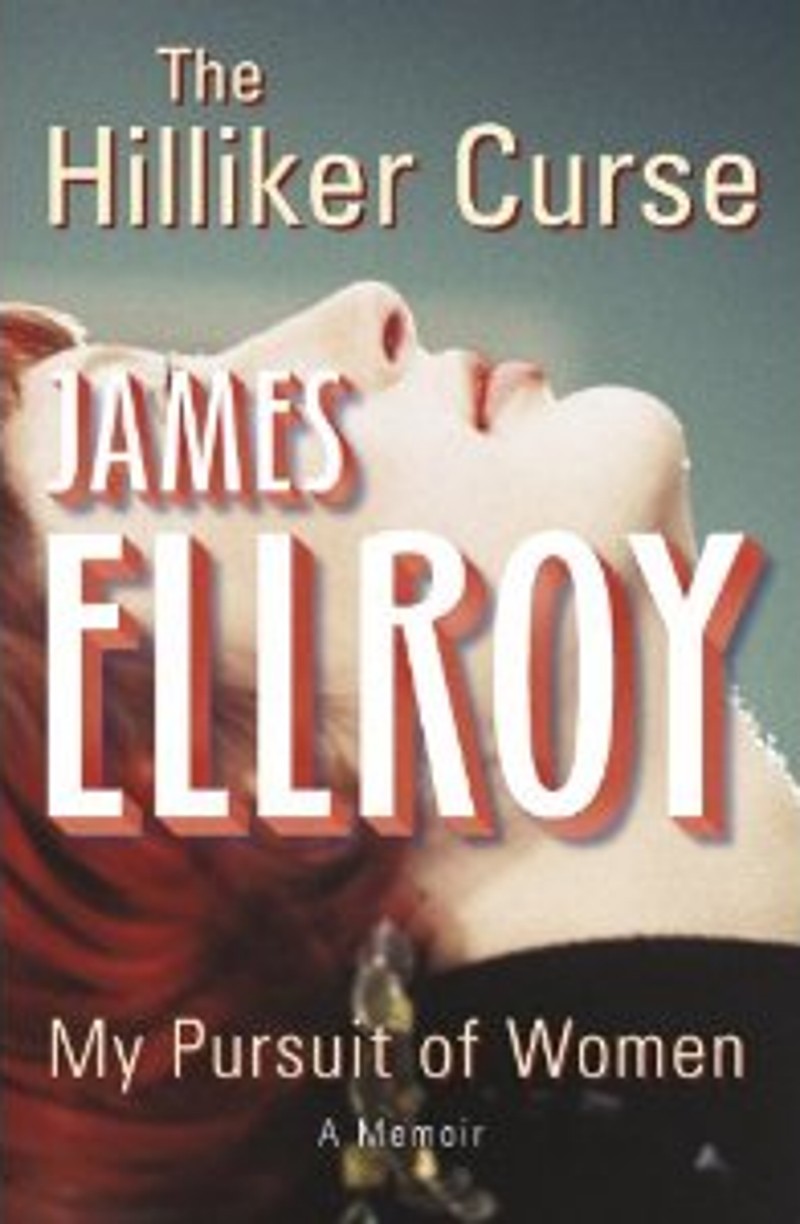
James Ellroy (right) was in town a couple of weeks ago, promoting THE HILLIKER CURSE, and the Evening Herald very kindly sent me along to interview him. The result went a lot like this:
May 28, ’04. Sacramento on a spring heat wave. The six thousandth public performance of my dead-mother act … A man called me glib. I brusquely rebuked him. I said she was my mother - not his. I said I’d paid the price - and he hadn’t.” - James Ellroy, The Hilliker Curse
First, the facts: James Ellroy’s mother, Geneva ‘Jean’ Hilliker, was murdered in 1958, when Ellroy was ten years old. Her killer was never caught. The boy ran wild, stalked women, broke into their houses to peep and prowl. Drug and booze addictions followed. He published his first novel, Brown’s Requiem, in 1981. Twelve more followed, including his breakout novel LA Confidential (1990) and the ‘Underworld’ trilogy of American Tabloid (1995), The Cold Six Thousand (2001) and Blood’s a Rover (2009), all of them riffing on a theme of brutal men avenging vulnerable women.
  Ellroy also wrote My Dark Places (1996), a memoir of the time he spent unsuccessfully investigating his mother’s death. The novel The Black Dahlia (1987), inspired by the true-life murder of actress Betty Short, was dedicated ‘in blood’ to the memory of Geneva Hilliker.
  The charge of exploiting his murder’s death is not one that Ellroy shies away from in his second memoir, The Hilliker Curse: My Pursuit of Women. When his then wife Helen Knode presented him with a photograph of himself taken in the immediate wake of his mother’s death, and asked him what he was thinking, Ellroy replied with a succinctly cold one-word answer: ‘Opportunity.’
  “Yeah, opportunity,” he says, easing back into the plush couch. Cue-ball bald, wild of eye, he is not in the least bit self-conscious about dissecting his mother’s murder amid the muted conversations of The Westbury’s lobby, where we meet shortly after Ellroy walked out on an interview with Today FM’s Matt Cooper after a short but robust exchange. “In Blood’s A Rover, Joan tells [the young, Ellroy-esque voyeur] Don Crutchfield, ‘Your options are do everything or do nothing.’ With my mother, my options are do everything or do nothing. I have decided to do everything. It’s who I am. I’m a pro-active, assertive kind of man, and it wasn’t until I realised that my mother and I comprised more of a love story than a death-and-murder story that I was able to conceive this book.”
  But hadn’t he already covered that ground in My Dark Places?
  “Well, I realised that I had earned - as arrogant as this sounds - the universal significance necessary to write a viable memoir, which has to be about something bigger than you, or you’re full of fucking shit. Misogynistic violence in My Dark Places versus the conjunction of men and women in The Hilliker Curse. I realised this book could be something I’ve never done before, which is an autobiographical essay. By that I mean this: I get to be the younger Ellroy describing his crazy shit, and the older, more mature Ellroy commenting editorially upon it.”
  The younger man, as Ellroy documents in forensic detail, was tortured by self-conjured demons. All things considered, would that younger Ellroy think that the older man had burned up those demons in laying the ‘Hilliker curse’ to rest?
  “Yes. I put those demons to very, very good use. What I say in the book is that the fount of my will was and is the ability to exploit misfortune. And I could write about my mother or ignore my mother, I could tell my mother’s story, I could address it once, reinterpret it a second time … I had options. And I think I chose the right one.”
  In terms of style, The Hilliker Curse is less frenzied than Ellroy’s recent fiction.
  “I am giving the reader a helping hand,” he says. “I am giving the reader more emotional breathing room, more rumination. It all comes back to the two Ellroy motifs - the immediacy of the physical description, when I’m younger or in early middle age, and the rumination. You get the highfaluting riff and you get the fuck-shit-fuck-motherfucker stuff interchangeably, and it works. It works here because it is the voice of a dying breed of man. I think that a lot of the mixed reviews in America to date are because it’s written in such a blunt, heterosexual, white male language. And there’s another issue that attends this, which is that it’s not the least ironic. It’s romantic. This book says There Is Someone Out There - Find Her. Go To Any Lengths. Whatever It Costs. Whatever It Takes.”
  The ‘Her’ is Erika Schickel, Ellroy’s current partner, and who is in the process of leaving her husband for the writer. “I reject this woman as anything less than God’s greatest gift to me,” he writes near the end of The Hilliker Curse. “She is an alchemist’s casting of Jean Hilliker and something much more. She commands me to step out of the dark and into the light.”
  “The thing that’s bothered me about the critical reception so far,” says Ellroy “is that people find it a sleazy book. In fact it’s a tender book, and Erika and I are real. I wrote the relationship up to where we were when I had to turn the book in for publication, so I guess people are allowed to be sceptical, given the empirical evidence of my bad behaviour that precedes it. But Erika and I will flourish. I know we’re going to last.”
  Is he happy?
  “I’m happy. And I’ve been happy for a long time because I go out and take a bite out of the world, and I kick the shit out of the world, and I express my emotions, tell Matt Cooper to fuck off …”
  So what’s next for James Ellroy?
  “I’m going to write bigger, more romantic books. I will not be coy, I will tell you for attribution what I’m doing next. I am going to write a second LA Quartet. I am taking characters from the first Quartet - The Black Dahlia, The Big Nowhere, LA Confidential and White Jazz - and the Trilogy - American Tabloid, The Cold Six Thousand and Blood’s A Rover - and placing them in LA during the month of Pearl Harbour as much younger people. World War II will also be a character in the book, and it’s that month, of Pearl Harbour in December 1941, in real time.”

  The Hilliker Curse: My Pursuit of Women by James Ellroy is published by William Heinemann (hb, 224pp, £16.99)

Sidebar: James Ellroy on …

God
“I’m rarely asked about it, but it’s in the novels that I’m a Christian. The men who learn self-sacrifice later rather than earlier, who make the big gesture so that others may live. Atonement, redemption - it’s always been there.”

Jonathan Franzen
“Jonathan Franzen - he’s so full of shit. He pulls this crap on his British publisher, with the typos, they have to pulp 80,000 books, it costs them a quarter of a million pounds? Fuck Jonathan Franzen.”

Beethoven
“I first heard Beethoven in 1960, some fifty years ago, and I flipped out. I love the Romantic composers, Beethoven most of all. He’s been a constant companion of mine all my life. He has in many ways provided the soundtrack for my life with women.”

Cormac McCarthy
“Cormac McCarthy is a stunning American original, he deserves the Nobel Prize for Literature. But he won’t win it, for four reasons: he’s male, he’s white, American and presumably heterosexual … I got pissed off, when I tried to read The Crossing, at the twelve or fourteen pages of Mexican Spanish. What the fuck? My name’s not Juan Ellroy.”

This feature first appeared in the Evening Herald

Tuesday, May 12, 2009

God Due To ‘Finally Give A Crap’ Next Week - Official

Apologies to all three regular readers of CAP for the rather hysterical headline, but with Ireland on the brink of making blasphemy illegal, I thought I’d get my retaliation in first. Quoth the Irish Times:
Minister for Justice Dermot Ahern proposes to insert a new section into the Defamation Bill, stating: “A person who publishes or utters blasphemous matter shall be guilty of an offence and shall be liable upon conviction on indictment to a fine not exceeding €100,000.”
  “Blasphemous matter” is defined as matter “that is grossly abusive or insulting in relation to matters held sacred by any religion, thereby causing outrage among a substantial number of the adherents of that religion; and he or she intends, by the publication of the matter concerned, to cause such outrage.” […]
  Labour spokesman on justice Pat Rabbitte is proposing an amendment to this section which would reduce the maximum fine to €1,000 and exclude from the definition of blasphemy any matter that had any literary, artistic, social or academic merit.
  Now, it’s not that I’m especially irreligious or anything – mainly because I don’t believe in God (above right), or gods, and it’s hard to get worked up either way about something you don’t believe in – but I am a fan of free speech and fair comment. If people want to believe that there’s a nebulous creator-type out there who takes a personal interest in their lives, then that’s okay with me, just so long as they don’t try stuffing it down my throat.
  The problem is, the throat-stuffing is on the rise world-wide, and Ireland – in the person of Minister for Justice Dermot Ahern – is joining ranks with other (koff) less progressive regimes. Mr Ahern claims that what he’s doing is actually making it impossible for anyone to be convicted of blasphemy in Ireland, which no one has in living memory, if ever, which kind of raises the question as to why he’d try to fix something that isn’t broken. Is it too cynical to wonder at the timing of the new legislation, given that Mr Ahern’s party, Fianna Fail, are about to get seven bells kicked out of them at the polls in the forthcoming local and European elections?
  Anyway, the good news is that the penalty for blasphemy – if you somehow manage to convince a jury of your peers in a modern democracy in the 21st century that you’ve managed to offend the sensibilities of a god so heedless of human affairs, and all the suffering wrought in its name, that it can’t be arsed to turn up for five minutes one day and say, ‘Whoa! The Hindus are the only ones getting it right,’ – anyway, the penalty is a hefty fine ‘not exceeding €100,000’. Which beats the hell out of a the rack, a stint in the Iron Maiden and being fried alive. Which, I guess, is progress, and at least we’re not living in Afghanistan or the Sudan. Three steps forward and two back, and all that.
  Incidentally, I saw Angels and Demons last week, and one of the characters, a cardinal, had a nice line. “God answers all prayers, my son – but sometimes he answers no.”
  Finally, if you hear on the grapevine in the next few days that I’ve been struck down by lightning / boils / a plague of frogs, then pick a god, any god. Better safe than sorry, eh? Even if you pick the wrong one, you’ll probably get a B+ for trying.
Declan Burke has published a number of novels, the most recent of which is ABSOLUTE ZERO COOL. As a journalist and critic, he writes and broadcasts on books and film for a variety of media outlets, including the Irish Times, RTE, the Irish Examiner and the Sunday Independent. He has an unfortunate habit of speaking about himself in the third person. All views expressed here are his own and are very likely to be contrary.