Showing posts with label Jonathan Franzen. Show all posts

Wednesday, July 2, 2014

Review: THE TRUTH ABOUT THE HARRY QUEBERT AFFAIR by Joël Dicker

The physical book may well be under threat from the digital revolution, but a growing number of crime writers have decided that books are more dangerous than endangered. In the last couple of months alone, Pierre Lamaitre’s Irene, Chris Pavone’s The Accident and Liz Nugent’s Unravelling Oliver have all told stories revolving around fictional books – and that’s good old-fashioned paper-and-cardboard books; none of your new-fangled device-friendly e-pub here, thanks, we’re talking books – that offer their characters plausible motives for mayhem and murder.
  The Truth About the Harry Quebert Affair (MacLehose, €14.99), the second novel from Swiss author Joël Dicker, although his first to be translated into English, is the latest thriller to suggest that an obsession with books can prove fatal. It opens with 28-year-old author Marcus Goldman enjoying a celebrity lifestyle in New York courtesy of his bestselling, critically acclaimed debut novel. At least, Marcus appears to be enjoying the life of a literary superstar: the toast of Manhattan’s elite, he is rich, famous and the most eligible bachelor in town. The truth is that Marcus should have begun his second novel a long time ago, but finds himself, with a deadline fast approaching, suffering from a severe case of writer’s block.
  Desperate to get back into his writing routine, Marcus contacts his former college professor and writing mentor, Harry Quebert. Now living in splendid isolation in the remote New Hampshire town of Somerset, Harry Quebert was acclaimed a genius and the leading light of his generation when he published The Origins of Evil in the mid-1970s. Harry urges Marcus to abandon New York and come to Somerset, to find the peace of mind he needs to write.
  Shortly after Marcus arrives in Somerset, the remains of a young girl are dug up on Harry’s property. When the body is identified as that of Nola Kellergan, a 15-year-old girl who went missing in Somerset in 1975, Harry confesses to Marcus that he had been in a relationship with Nola when she disappeared; when it is discovered that the skeleton is clutching a hand-written manuscript of The Origins of Evil, Harry is arrested and charged with Nola Kellergan’s murder.
  The book-within-a-book game doesn’t end there; determined to clear his friend’s name, Marcus embarks on an investigation in tandem with police detective Perry Gahalawood, planning to publish the results of his findings as a book called The Harry Quebert Affair.
  A publishing sensation even before its translation into English – it has already sold in excess of two million copies, with translation rights sold for 32 countries – The Truth About the Harry Quebert Affair is being described as a ‘literary thriller’, and has been compared to Jonathan Franzen and Philip Roth. This is, presumably, on the basis that it is so firmly embedded in the publishing industry – a novel narrated by an author, investigating the literary origins of a famous author’s novel, all the while writing a book about his investigations. Further, each chapter is prefaced with a short dialogue between the younger Marcus Goldman and his mentor Harry Quebert, in which Harry offers his rules for writing.
  Despite its extensive engagement with writers and the business of writing, however, The Truth About the Harry Quebert Affair is by no means a literary thriller. Its prose is neither elegant nor eloquent, and while language often suffers in translation, it’s worth noting that the translator here, Sam Taylor, also translated Laurent Binet’s superb HHhH.
  That said, it’s only fair to say that Joël Dicker isn’t responsible for how his novel is marketed, and that the book doesn’t read as if it were written for a literary audience. Its take on writer’s block, for example, is the unsophisticated notion of an author staring for weeks on end at a blank page, or feverishly scrawling the same word over and over again. A novel is routinely declared ‘great’ or ‘a masterpiece’ while its author is still halfway through its first draft; the story is chock-a-block with reversals of fortune and explosively dramatic reveals rather than the subtly nuanced characterisations and narrative developments we have come to expect from John le Carré and similar masters of the literary thriller.
  Indeed, from very early on it’s clear that Dicker’s ambition is to write a pacy, melodramatic pot-boiler. The rustic New England setting is deftly sketched in, but otherwise realism is at a premium: the depiction of the publishing industry errs on the grotesque side of parody, for example, while it’s highly unlikely, to say the least, that a hardboiled New England cop would agree to allow a bestselling novelist hijack his murder investigation with the stated intention of establishing an alleged child murderer’s innocence. Characters fall in love at the drop of a manuscript, and there are enough skeletons in closets to dance a conga down Main Street. The crucial revelation that drives the novel’s final stages, meanwhile, appears to have been parachuted in from another kind of novel entirely.
  By that point, however, and having already negotiated a couple of thriller’s worth of improbable twists and turns, you’re likely to be conditioned to forgive Joël Dicker virtually any kind of narrative extravagance. The Truth About the Harry Quebert Affair is thriller escapism writ large, irrepressibly exuberant storytelling that tramples realism underfoot as it rattles along at a thunderous pace.
  Yet for all its clunky dialogue and lurid melodrama, there is an undeniably endearing quality to Marcus Goldman’s – and possibly even Joël Dicker’s – faith in the genre’s fundamental conceit, that whimsical but tempting notion that justice can be served and the world made better if only we believe strongly enough in the redemptive power of truth. And once the book is finished and put back in the beach-bag, or stored in the overhead locker, what remains with the reader is the novel’s quiet heart, the heartbreaking poignancy of the image on which it all turns, that of the body of a murdered 15-year-old girl uncovered in a shallow grave and still clutching, three decades after her death, a beloved handwritten manuscript. ~ Declan Burke

  This review was first published in the Irish Times.

Monday, May 9, 2011

“Ya Wanna Do It Here Or Down The Station, Punk?”: Andrew Pepper

Yep, it’s rubber-hose time, folks: a rapid-fire Q&A for those shifty-looking usual suspects ...

What crime novel would you most like to have written?
RED HARVEST by Dashiell Hammett – the original hard-boiled crime novel and still the best. David Peace’s Red Riding Quartet – four astonishing novels that made me feel physically ill by the time I’d finished them (in a good way). THE POWER OF THE DOG by Don Winslow is a thing of awe and wonder – visceral, finger-chewing stuff and the last word on the lamentable ‘war on drugs’ and the limitations of American power. Anything bleak and angry that asks the right questions but knows not to try and provide answers. Newton Thornburg’s CUTTER AND BONE is another novel I’d loved to have written. Failure and despair are all but inevitable but that doesn’t mean you have to give up. And each time I read the part where Cutter tries to ‘park’ his car I weep with laughter.

What fictional character would you most like to have been?
Chief Bromden played a cagier game than McMurphy and managed to side-step the lobotomy.

Who do you read for guilty pleasures?
Student essays.

Most satisfying writing moment?
Whenever you know you absolutely should be doing something else and yet you still feel somehow compelled to sit in front of the screen and type away – and before you know it an hour, two hours, four hours, have passed since you last thought to check the time.

The best Irish crime novel is …?
THE ULTRAS by Eoin McNamee. It’s spare, terse, poetic; it disorientates you and never lets you settle; it delves deep into minds of its characters but never gives you the answers you expect; it tells a gripping and gut-churning story about complicity and state violence without succumbing to political posturing or cliché.

What Irish crime novel would make a great movie?
WINTERLAND by Alan Glynn – I see Richard Gere channelling his best ‘Jackal’ voice for the part of Paddy Norton and Julia Roberts reprising her star turn from ‘Mary Reilly’ in the role of Gina Rafferty.

Worst / best thing about being a writer?
Best: Monday 10.37am – everything is great, you’re great, what you’re writing is great, not just great, it’s going to blow every other crime novel ever written out of the water. Great is a word, daring is another, because what you’re doing is ripping up the genre into tiny little pieces and letting them fall where they may on the page …

Worst: Monday 12.13pm – you’ve spent the last half hour picking up those pieces of paper and carefully sellotaping them back into some kind of recognisable order. The result is a piece of writing so dreary and predictable, so utterly moribund, that it could creosote Alan Shearer’s shed and still have time to put in a full shift at the call centre. Not only does it suck, you suck, you’re a fraud, and worse, a coward, and just when you think you can’t sink any lower you’re watching a repeat of ‘Bargain Hunt’ which you know is a repeat because you’ve seen it before …

The pitch for your next book is …?
I slip into the leather booth and when the movie producer asks this same question, I lean across the table and whisper, “Karl Marx meets ‘The Talented Mr Ripley’.” The producer smiles to reveal teeth as white as Belfast (circa 1997) and says, “I saw a Karl Malden movie once.” Not listening, I reply, ‘He was German.” He says, ‘In ‘On the Waterfront’?” I grimace a little and remember to thank him for the first-class flights and the suite at the Chateau Marmont. “Who’s going to play the Marlon Brando role?” says he. I frown. “It’s a searing indictment of the ills of global capitalism.” He checks his phone. “Have you thought about Justin Bieber?”

Who are you reading right now?
Jonathan Franzen’s FREEDOM. I always feel uplifted when I read proper literature.

God appears and says you can only write OR read. Which would it be?
First I’d ask God to do his Morgan Freeman impression. Then I’d ask him about the Old Testament and what happened to his sense of humour. Then I’d select the latter option. Anyone can write. Reading is for the chosen few.

The three best words to describe your own writing are …?
Be. Less. Shit.

Andrew Pepper’s BLOODY WINTER is published by W&N.

Sunday, October 24, 2010

The Gospel According To James

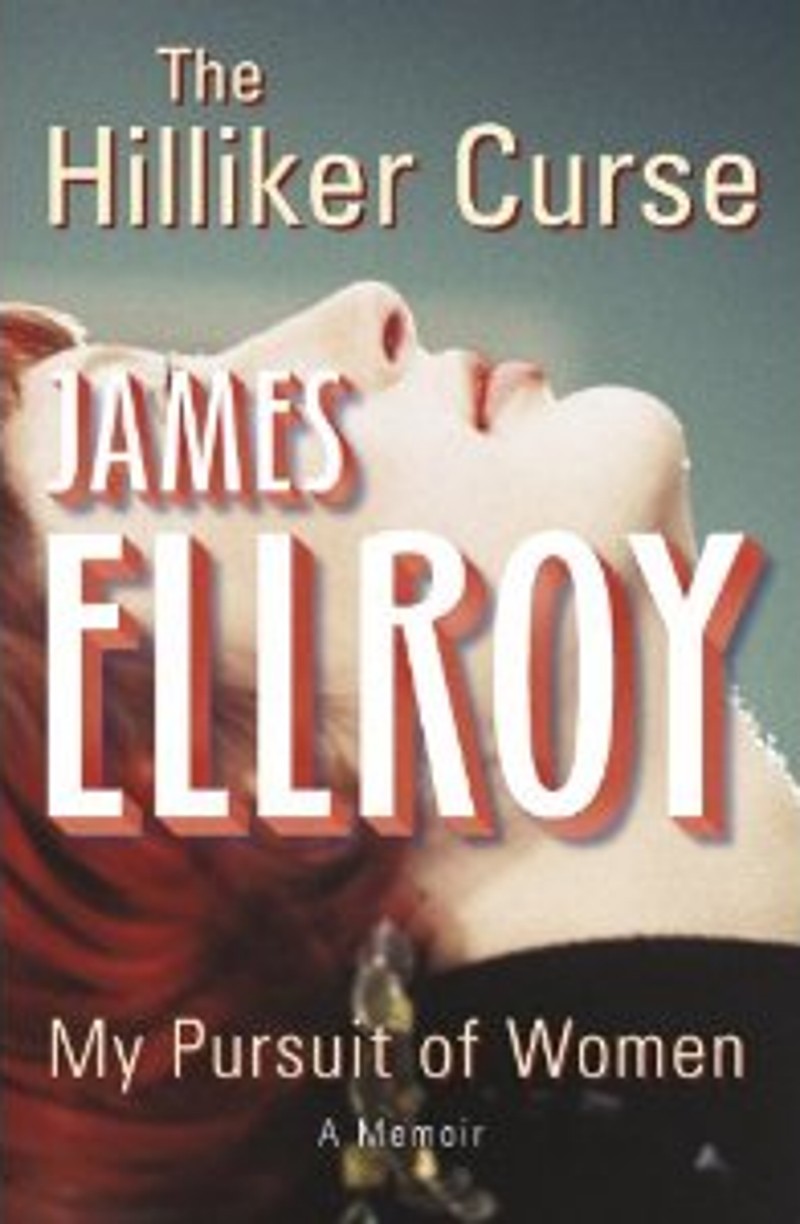
James Ellroy (right) was in town a couple of weeks ago, promoting THE HILLIKER CURSE, and the Evening Herald very kindly sent me along to interview him. The result went a lot like this:
May 28, ’04. Sacramento on a spring heat wave. The six thousandth public performance of my dead-mother act … A man called me glib. I brusquely rebuked him. I said she was my mother - not his. I said I’d paid the price - and he hadn’t.” - James Ellroy, The Hilliker Curse
First, the facts: James Ellroy’s mother, Geneva ‘Jean’ Hilliker, was murdered in 1958, when Ellroy was ten years old. Her killer was never caught. The boy ran wild, stalked women, broke into their houses to peep and prowl. Drug and booze addictions followed. He published his first novel, Brown’s Requiem, in 1981. Twelve more followed, including his breakout novel LA Confidential (1990) and the ‘Underworld’ trilogy of American Tabloid (1995), The Cold Six Thousand (2001) and Blood’s a Rover (2009), all of them riffing on a theme of brutal men avenging vulnerable women.
  Ellroy also wrote My Dark Places (1996), a memoir of the time he spent unsuccessfully investigating his mother’s death. The novel The Black Dahlia (1987), inspired by the true-life murder of actress Betty Short, was dedicated ‘in blood’ to the memory of Geneva Hilliker.
  The charge of exploiting his murder’s death is not one that Ellroy shies away from in his second memoir, The Hilliker Curse: My Pursuit of Women. When his then wife Helen Knode presented him with a photograph of himself taken in the immediate wake of his mother’s death, and asked him what he was thinking, Ellroy replied with a succinctly cold one-word answer: ‘Opportunity.’
  “Yeah, opportunity,” he says, easing back into the plush couch. Cue-ball bald, wild of eye, he is not in the least bit self-conscious about dissecting his mother’s murder amid the muted conversations of The Westbury’s lobby, where we meet shortly after Ellroy walked out on an interview with Today FM’s Matt Cooper after a short but robust exchange. “In Blood’s A Rover, Joan tells [the young, Ellroy-esque voyeur] Don Crutchfield, ‘Your options are do everything or do nothing.’ With my mother, my options are do everything or do nothing. I have decided to do everything. It’s who I am. I’m a pro-active, assertive kind of man, and it wasn’t until I realised that my mother and I comprised more of a love story than a death-and-murder story that I was able to conceive this book.”
  But hadn’t he already covered that ground in My Dark Places?
  “Well, I realised that I had earned - as arrogant as this sounds - the universal significance necessary to write a viable memoir, which has to be about something bigger than you, or you’re full of fucking shit. Misogynistic violence in My Dark Places versus the conjunction of men and women in The Hilliker Curse. I realised this book could be something I’ve never done before, which is an autobiographical essay. By that I mean this: I get to be the younger Ellroy describing his crazy shit, and the older, more mature Ellroy commenting editorially upon it.”
  The younger man, as Ellroy documents in forensic detail, was tortured by self-conjured demons. All things considered, would that younger Ellroy think that the older man had burned up those demons in laying the ‘Hilliker curse’ to rest?
  “Yes. I put those demons to very, very good use. What I say in the book is that the fount of my will was and is the ability to exploit misfortune. And I could write about my mother or ignore my mother, I could tell my mother’s story, I could address it once, reinterpret it a second time … I had options. And I think I chose the right one.”
  In terms of style, The Hilliker Curse is less frenzied than Ellroy’s recent fiction.
  “I am giving the reader a helping hand,” he says. “I am giving the reader more emotional breathing room, more rumination. It all comes back to the two Ellroy motifs - the immediacy of the physical description, when I’m younger or in early middle age, and the rumination. You get the highfaluting riff and you get the fuck-shit-fuck-motherfucker stuff interchangeably, and it works. It works here because it is the voice of a dying breed of man. I think that a lot of the mixed reviews in America to date are because it’s written in such a blunt, heterosexual, white male language. And there’s another issue that attends this, which is that it’s not the least ironic. It’s romantic. This book says There Is Someone Out There - Find Her. Go To Any Lengths. Whatever It Costs. Whatever It Takes.”
  The ‘Her’ is Erika Schickel, Ellroy’s current partner, and who is in the process of leaving her husband for the writer. “I reject this woman as anything less than God’s greatest gift to me,” he writes near the end of The Hilliker Curse. “She is an alchemist’s casting of Jean Hilliker and something much more. She commands me to step out of the dark and into the light.”
  “The thing that’s bothered me about the critical reception so far,” says Ellroy “is that people find it a sleazy book. In fact it’s a tender book, and Erika and I are real. I wrote the relationship up to where we were when I had to turn the book in for publication, so I guess people are allowed to be sceptical, given the empirical evidence of my bad behaviour that precedes it. But Erika and I will flourish. I know we’re going to last.”
  Is he happy?
  “I’m happy. And I’ve been happy for a long time because I go out and take a bite out of the world, and I kick the shit out of the world, and I express my emotions, tell Matt Cooper to fuck off …”
  So what’s next for James Ellroy?
  “I’m going to write bigger, more romantic books. I will not be coy, I will tell you for attribution what I’m doing next. I am going to write a second LA Quartet. I am taking characters from the first Quartet - The Black Dahlia, The Big Nowhere, LA Confidential and White Jazz - and the Trilogy - American Tabloid, The Cold Six Thousand and Blood’s A Rover - and placing them in LA during the month of Pearl Harbour as much younger people. World War II will also be a character in the book, and it’s that month, of Pearl Harbour in December 1941, in real time.”

  The Hilliker Curse: My Pursuit of Women by James Ellroy is published by William Heinemann (hb, 224pp, £16.99)

Sidebar: James Ellroy on …

God
“I’m rarely asked about it, but it’s in the novels that I’m a Christian. The men who learn self-sacrifice later rather than earlier, who make the big gesture so that others may live. Atonement, redemption - it’s always been there.”

Jonathan Franzen
“Jonathan Franzen - he’s so full of shit. He pulls this crap on his British publisher, with the typos, they have to pulp 80,000 books, it costs them a quarter of a million pounds? Fuck Jonathan Franzen.”

Beethoven
“I first heard Beethoven in 1960, some fifty years ago, and I flipped out. I love the Romantic composers, Beethoven most of all. He’s been a constant companion of mine all my life. He has in many ways provided the soundtrack for my life with women.”

Cormac McCarthy
“Cormac McCarthy is a stunning American original, he deserves the Nobel Prize for Literature. But he won’t win it, for four reasons: he’s male, he’s white, American and presumably heterosexual … I got pissed off, when I tried to read The Crossing, at the twelve or fourteen pages of Mexican Spanish. What the fuck? My name’s not Juan Ellroy.”

This feature first appeared in the Evening Herald

Thursday, September 2, 2010

“Ya Wanna Do It Here Or Down The Station, Punk?”: Todd Ritter

Yep, it’s rubber-hose time, folks: a rapid-fire Q&A for those shifty-looking usual suspects ...

What crime novel would you most like to have written?
MYSTIC RIVER by Dennis Lehane. Damn, that guy can write, and the book deserved a Pulitzer.

What fictional character would you most like to have been?
The Man in the Yellow Hat from CURIOUS GEORGE, because it would be pretty cool to have a monkey.

Who do you read for guilty pleasures?
Sandra Brown. She’s like fast food. I don’t have it often and it’s really bad for me, but it tastes so good.

Most satisfying writing moment?
Writing the last sentence of my debut novel and knowing that the whole thing didn’t suck.

The best Irish crime novel is …?
I’ll have to go with THE LIKENESS by Tana French, because she impresses the hell out of me.

What Irish crime novel would make a great movie?
I’m not sure if this is allowed, since it’s not a novel (sorry!), but Martin McDonagh’s THE LIEUTENANT OF INISHMORE would be a fantastic movie. Or maybe that’s too bloody. I really flubbed this question, didn’t I?

Worst / best thing about being a writer?
Best: Entertaining readers by giving them a good yarn. Worst: Facing that blank screen and knowing I have to fill it.

The pitch for your next book is …?
A cop and a private investigator look into a series of child abductions from decades ago, all of which coincided with NASA moon landings. Coincidence? Probably not.

Who are you reading right now?
FREEDOM by Jonathan Franzen. When a book gets this much press, I have to read it.

God appears and says you can only write OR read. Which would it be?
Read, because I like to be surprised by others.

The three best words to describe your own writing are …?
Morbid. Surprising. Sympathetic.

Todd Ritter’s DEATH NOTICE is published by Minotaur Books.
Declan Burke has published a number of novels, the most recent of which is ABSOLUTE ZERO COOL. As a journalist and critic, he writes and broadcasts on books and film for a variety of media outlets, including the Irish Times, RTE, the Irish Examiner and the Sunday Independent. He has an unfortunate habit of speaking about himself in the third person. All views expressed here are his own and are very likely to be contrary.