Yep, it’s rubber-hose time, folks: a rapid-fire Q&A for those shifty-looking usual suspects ...
What crime novel would you most like to have written?
The Silence of the Lambs should have been by me and not that Thomas Harris. Although, if I’d written it, there would have been some terrible swearing and scenes of a sexual nature in it that didn’t necessarily involve cannibalism or fava beans. But still, what a great baddy! Hannibal Lecter was the first villain I had fallen for since Darth Vader.
What fictional character would you most like to have been?
Probably Lisbeth Salander, who inspired, in no small part, my heroine, George McKenzie. Salander is whizzy with technology and surly. I’m a luddite and loud-mouth. I don’t do silent and smouldering well at all, which Salander does. It’s that Scandinavian vs Celt/Eastern European Mancunian thing. I come from a long line of big-gobbed tough women. We don’t do poise or studied cool. Plus, Salander always seems to have good hair. I’m a middle-aged woman. My hairline is receding. My appendages are hitting the deck. It’s not nice on any level. Anyway, though George McKenzie is young and kickass like Salander, she is gobby like me (although she has a reassuringly hairy head).
Who do you read for guilty pleasures?
I read an awful lot of children’s fiction – hardly surprising, since I started out as a children’s author. Children’s fiction is written in a sparing and economical way, which gives an adventure novel a real sense of urgency. Middle-grade is my favourite age banding. I love Eoin Colfer, Frank Cottrell-Boyce and the Young Bond series by Charlie Higson and now, Steve Cole.
Most satisfying writing moment?
When I’ve spent an entire day, writing one paragraph and trying to get a clever metaphor just right. These are the bits I agonise over, but when I read them back, I think, wow. I can actually write. Then I get the odd one star howler back that says I went off at a tangent or that they had to skip a paragraph because “it got boring”. Those are the clever bits, you one-star-howling berk!!
If you could recommend one Irish crime novel, what would it be?
Now, I had to take this under advisement, since I can’t claim to have read widely in the Irish crime genre. My friend and book reviewer, Bookwitch, tells me the best crime novels are Adrian McKinty’s Sean Duffy series. I couldn’t specify one in particular and neither would she.
What Irish crime novel would make a great movie?
Declan Burke’s Crime Always Pays. It’s a very funny, very visual crime novel. The tight plotting, great dialogue and intriguing characters are all there. Humour and crime translate well to the big screen, as demonstrated by my favourites, In Bruges and The Guard.
Worst / best thing about being a writer?
Worst thing about being a writer is getting that one star howler of a review. There’s always some smart arse who sussed the killer by page ten, or who really couldn’t get any of your characters and thought the whole thing was tedious beyond belief. You can’t quite believe a story that took you years to write – two, in the case of The Girl Who Wouldn’t Die – can be dismissed in a short paragraph. That bit SUCKS, as does watching your book slide back in the Amazon rankings into obscurity. On the bright side, the best bit is ... well, most of it. I love working alone, talking to myself aloud about plot points, allowing my characters to become real to me, picking my nose without fear of discovery, sitting in my pyjama bottoms without fear of fashion or hygiene judgement. All the things you get up to when you’re in a small, enclosed space without supervision and with the aid of alcoholic drink ... Then, realising post-publication that people love what I’ve written and totally get my characters and absolutely didn’t sodding work out who the killer was by page ten. Those are the best bits.
The pitch for your next book is …?
In The Girl Who Broke the Rules – book 2 of the George McKenzie series – the heroine, George, gets to hang out with a grade A perv who equals Hannibal Lecter in both his finesse, his intellectual prowess and his aptitude for murder. George, together with Chief Inspector Paul van den Bergen of the Dutch police, must work out who is committing a string of brutal serial killings, where victims are sliced open and emptied of their innards! There’s sex, drugs and shenanigans in Amsterdam’s red light district. It’s Silence of the Lambs meets Trainspotting!
Who are you reading right now?
I’m reading Jo Nesbo’s The Son right now, along with Angela Marsons’ Silent Scream, but I’ve just finished The Farm by Tom Rob Smith which I enjoyed hugely.
God appears and says you can only write OR read. Which would it be?
Write. Sometimes, all the naughty just has to come out.
The three best words to describe your own writing are …?
Gritty, gripping, intelligent. Well, you could swap intelligent for naughty if you’re, you know, a bit funny about the swearing and the nookie and the violence.
THE GIRL WHO WOULDN’T DIE by Marnie Riches is published by Maze.
Showing posts with label Jo Nesbo. Show all posts
Thursday, April 30, 2015
Friday, February 27, 2015
Exhibition: Ger Holland at dlr Lexicon
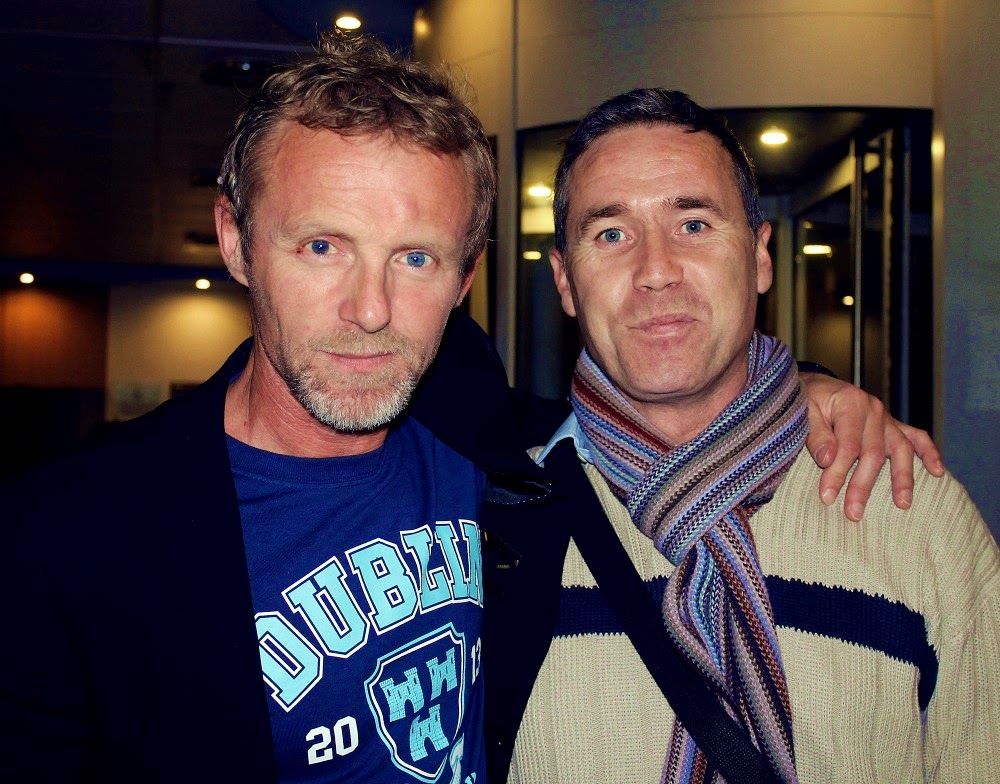
I’m not entirely sure why I look so constipated in this photograph with Jo Nesbo, although it’s possible that I’m being slowly strangled by that rare, multi-coloured Dun Laoghaire python that has leapt onto my neck. Anyway, the pic was taken by the very talented Ger Holland, who has become synonymous with photography at literary events in Ireland over least few years. Ger has her first exhibition of photographs next week, Tuesday March 3rd, and as you’d imagine, she’s delighted about it all:
“I’m delighted to welcome you all to my first exhibition in the dlr Lexicon in Dun Laoghaire, Co. Dublin. The exhibition features 40 photographs that I have taken of writers at the Mountains to Sea dlr Book Festivals over the last three years and from 16 different dlr Library Voices events, including Jo Nesbo, Donna Tartt, Ian McEwan and Armistead Maupin.”For all the details, clickety-click here …
Friday, January 3, 2014
Review: THE ELOQUENCE OF THE DEAD by Conor Brady
Conor Brady made his debut as a historical crime novelist with A June of Ordinary Murders (2011), and that novel’s hero, Detective Sergeant Joe Swallow of the Dublin Metropolitan Police ‘G-Men’ Division, makes a welcome return in THE ELOQUENCE OF THE DEAD (New Island). The novel opens in Galway in 1887, with Lady Gessel bidding a none-too-fond farewell to her estate as she prepares to sell her family’s ancestral home, as so many of her peers are doing, and move to England. Meanwhile, back in Dublin, Swallow is called in to investigate the murder of a pawnbroker in the Liberties area, a man who appears to have paid a very harsh price for handling stolen goods. How these events are connected gradually emerges in a propulsive but stylish tale of conspiracy and corruption on a grand scale. Swallow, a keen amateur painter, brings a sharp eye to bear on his surroundings, which in turn allows Brady to give us a vivid account of late Victorian Dublin in all its squalid glory. The result is a very satisfying police procedural / mystery and an equally fine historical novel. ~ Declan Burke
This review was first published in the Irish Times, in a column that also included reviews of the latest titles from Jo Nesbo, Sophie Loubiere, Conor Fitzgerald and John Lawton.
Labels:
Conor Brady,
Irish mystery fiction,
Jo Nesbo,
John Lawton,
Sophie Loubiere,
The Eloquence of the Dead,
Victorian Dublin
Thursday, October 3, 2013
Review: TAMPA by Alissa Nutting
Celeste Price, the narrator of Alissa Nutting’s debut novel Tampa (Faber & Faber, €14.99), is a high school English teacher in Florida. Married to a local police officer, Celeste is friendly, helpful and dedicated in her vocation. Respectability personified, she harbours a dark secret: Celeste has made it her life’s work to put herself in a position where she can prey sexually on 14-year-old boys. It’s a chilling tale in many respects, not least because Celeste suffers no crisis of conscience about her deviant behaviour and the effect it might have on the young men she targets, but it’s very difficult for the reader to dislike Celeste herself. Her first-person voice is charming, self-deprecating and witty, the amiable tone drawing the reluctantly complicit reader deeper and deeper into her immorality. There are echoes of Humbert Humbert and Tom Ripley to be heard here, and also Jim Thompson’s charming psychopath Lou Ford (Celeste’s husband is called Ford), but Nutting’s reinvention of the taboo-breaking femme fatale results in a self-determining female protagonist reminiscent of those created in recent years by Gillian Flynn and Megan Abbott. That said, Celeste Price is a unique creation and Tampa is a singular tale. It may well be the most challenging crime novel you’ll read all year. – Declan Burke
This review was first published in the monthly crime fiction column in the Irish Times. Also reviewed were the latest offerings from Jo Nesbo, Nele Neuhaus and Joe Joyce.
Labels:
Alissa Nutting,
Gillian Flynn,
Jim Thompson,
Jo Nesbo,
Joe Joyce,
Megan Abbott,
Nele Neuhaus,
Tampa
Sunday, September 8, 2013
There’s No Show Like A Jo Show
I’m very much looking forward to meeting again with Jo Nesbo (right), when I interview him for the DLR Library Voices series on Tuesday, September 16th. I met with Jo Nesbo a couple of years ago, to interview him for a newspaper feature, and it was all very pleasant indeed. He’s a charming guy – ladies of my acquaintance lead me to believe that he’s rather handsome to boot – and wears the mantle of Nordic crime’s brightest star very lightly indeed.
On the evening in question we’ll be talking about Jo’s latest Harry Hole novel, POLICE, but I’d imagine it’ll be a fairly wide-ranging chat about the Harry Hole series in general, Jo’s standalone novels, and the Scandi Noir phenomenon. Here’s the official blurb:
Jo Nesbo is a musician, songwriter, economist and internationally acclaimed author. He is also the undisputed king of the Nordic crime fiction boom with sales of 14 million copies worldwide. POLICE is the tenth novel in the Harry Hole series which has been described by one critic as “exuberantly, ingeniously gruesome”. Nesbo’s haunted protagonist has been at the centre of every major criminal investigation in Oslo. His brilliant insights have saved the lives of countless people. But now, with those he loves most facing terrible danger, Harry can’t protect anyone, least of all himself. Jo Nesbo is one of the hottest properties in international publishing. Don’t miss him.For all the details, including how to book tickets, clickety-click here …
Labels:
Declan Burke,
DLR Library Voices,
Harry Hole,
Jo Nesbo,
Police,
Scandi Noir
Monday, July 2, 2012
“Ya Wanna Do It Here Or Down The Station, Punk?”: Eoin Colfer
Yep, it’s rubber-hose time, folks: a rapid-fire Q&A for those shifty-looking usual suspects ...
What crime novel would you most like to have written?
I would love to have written SILENCE OF THE LAMBS, and not just for all the residuals and royalties, but also because it is a groundbreaker and I think that is a part of what all writers are trying to do; redefine a genre, become the new standard. And I think that is what Thomas Harris did with SILENCE.
What fictional character would you most like to have been?
I think I would like to have been Doctor Watson. Watson followed Holmes around taking notes, so he was involved in the thrilling adventures but also got to do what I love best: write. Having to fight in the Afghan wars might be a bit of a drawback.
Who do you read for guilty pleasures?
I do occasionally fall back on the big crime writers like Jo Nesbo or Michael Connelly. They are always reliable fun, especially on a holiday. Of course I seethe with jealousy as I read but these guys undeniably put a top class thriller together. John Sandford is another one.
Most satisfying writing moment?
I think when Artemis Fowl was voted the UK’s favourite Puffin Classic ever. In your face, Roald Dahl. Sorry, that was childish.
The best Irish crime novel is …?
That’s a hard one. I do like me a bit of Ken Bruen. I love AMERICAN SKIN. But I would have to throw EIGHTBALL BOOGIE in there, and also an old collaboration novel I really enjoyed called YEATS IS DEAD in which Pauline McLynn and Marian Keyes totally crushed the opposition.
What Irish crime novel would make a great movie?
I think my last crime book, PLUGGED, would be a good a good movie, but besides my stuff I think MYSTERY MAN by Colin Bateman would possibly be the funniest crime movie ever, in the right hands. It’s probably being made as I type.
Worst / best thing about being a writer?
The best thing about being a writer is that you are allowed to choose your own music in the office and also build a shrine to your own accomplishments. The worst thing is that there are not many things sadder than a middle aged man looking at pictures of himself when he was for a brief moment cool, while listening to Whitesnake.
The pitch for your next book is …?
It’s a time travel trilogy where the FBI have discovered a wormhole and are using it to hide federal witnesses in the past.
Who are you reading right now?
I am reading SNOWDROPS by AD Miller, a brilliant evocation of new Russia and the crime that is rife there.
God appears and says you can only write OR read. Which would it be?
I would have to say read. Otherwise I could only read my own stuff and how shit would that be. Especially since I wrote it.
The three best words to describe your own writing are …?
Day by Day.
Eoin Colfer’s THE LAST GUARDIAN, the last in the Artemis Fowl series of novels, is published by Puffin.
What crime novel would you most like to have written?
I would love to have written SILENCE OF THE LAMBS, and not just for all the residuals and royalties, but also because it is a groundbreaker and I think that is a part of what all writers are trying to do; redefine a genre, become the new standard. And I think that is what Thomas Harris did with SILENCE.
What fictional character would you most like to have been?
I think I would like to have been Doctor Watson. Watson followed Holmes around taking notes, so he was involved in the thrilling adventures but also got to do what I love best: write. Having to fight in the Afghan wars might be a bit of a drawback.
Who do you read for guilty pleasures?
I do occasionally fall back on the big crime writers like Jo Nesbo or Michael Connelly. They are always reliable fun, especially on a holiday. Of course I seethe with jealousy as I read but these guys undeniably put a top class thriller together. John Sandford is another one.
Most satisfying writing moment?
I think when Artemis Fowl was voted the UK’s favourite Puffin Classic ever. In your face, Roald Dahl. Sorry, that was childish.
The best Irish crime novel is …?
That’s a hard one. I do like me a bit of Ken Bruen. I love AMERICAN SKIN. But I would have to throw EIGHTBALL BOOGIE in there, and also an old collaboration novel I really enjoyed called YEATS IS DEAD in which Pauline McLynn and Marian Keyes totally crushed the opposition.
What Irish crime novel would make a great movie?
I think my last crime book, PLUGGED, would be a good a good movie, but besides my stuff I think MYSTERY MAN by Colin Bateman would possibly be the funniest crime movie ever, in the right hands. It’s probably being made as I type.
Worst / best thing about being a writer?
The best thing about being a writer is that you are allowed to choose your own music in the office and also build a shrine to your own accomplishments. The worst thing is that there are not many things sadder than a middle aged man looking at pictures of himself when he was for a brief moment cool, while listening to Whitesnake.
The pitch for your next book is …?
It’s a time travel trilogy where the FBI have discovered a wormhole and are using it to hide federal witnesses in the past.
Who are you reading right now?
I am reading SNOWDROPS by AD Miller, a brilliant evocation of new Russia and the crime that is rife there.
God appears and says you can only write OR read. Which would it be?
I would have to say read. Otherwise I could only read my own stuff and how shit would that be. Especially since I wrote it.
The three best words to describe your own writing are …?
Day by Day.
Eoin Colfer’s THE LAST GUARDIAN, the last in the Artemis Fowl series of novels, is published by Puffin.
Labels:
Ad Miller,
Colin Bateman,
Eoin Colfer Artemis Fowl The Last Guardian,
Jo Nesbo,
John Sandford,
Ken Bruen,
Marian Keyes,
Michael Connelly,
Pauline McLynn,
Roald Dahl,
Thomas Harris,
Whitesnake
Thursday, April 7, 2011
A Very Black Hole
I met with Jo Nesbo (right) last month, to interview him on the publication of the latest Harry Hole novel, THE LEOPARD. The result read a lot like this:The cover of THE LEOPARD, the eighth in Jo Nesbo’s series of Harry Hole novels, bears a sticker saying, ‘The next Stieg Larsson’. This is not something that has Nesbo, a Norwegian, jumping for joy.
“I guess every writer doesn’t want to be compared other writers,” he shrugs, “and it’s not like I’m enthusiastic about it. I’m thinking okay, you want to use that sticker, it probably could have been worse. It could have been ‘The next Dan Brown’ (laughs).”
When we meet in the plush surroundings of the Westbury Hotel, Nesbo appears to have little in common with his most famous creation. Harry Hole is a morose character, a hard-drinking loner and a self-destructive detective with the Oslo Crime Squad who pursues and is pursued by demons in equal measure. Nesbo, on the other hand, is a lively interviewee, outgoing and articulate.
Both men, however, share a fascination with evil.
“I remember when I was going to school,” he says, “and there was this guy who sat in the window row. And he would catch flies on the window-sill, and he had brought a tweezers, and he would pull off one wing and two feet, something like that. And part of me, as kids always are, was fascinated as to what would happen to the fly, but what made me more fascinated was that this guy would do this thing day in, day out, and that he had brought the tweezers. Just the idea of him being at home in the morning, planning it - ‘Oh, I’ll bring a tweezers, so I can torture a fly.’ I thought that was really evil. And I wondered, could that be me? Or is this kid just a mean character, and I could never be anything like that? Or is it just coincidence that he’s killing flies and I’m not? Has it to do with upbringing? Are you born that way? And that’s really what I’m writing about - those kind of people. Why do they do it? What’s in it for them?”
As a boy, Nesbo had a very catholic taste in literature.
“From a very young age, it was Mark Twain, when I read TOM SAWYER. And later, Charles Dickens, who I only started reading some years ago, but I had OLIVER TWIST read to me when I was young. Later on it would be Norwegian writers like Knut Hamsun, and then some American writers, Charles Bukowski, Jack Kerouac, the Beatnik generation … Ernest Hemingway was a big influence. And a lot of Norwegian writers (laughs) that you probably haven’t heard about.
“My mother was a librarian, so she would bring books home. My father was also a keen reader, so there would always be lots of books around where I grew up. And later on, many of my friends would be planning to become the next big European writer. So we would gather in this café, dressed in the long coats we had bought from the Salvation Army, and sucking in our cheeks to look hungry (laughs), and discuss literature. Dostoevsky and Hamsun, y’know, although we hadn’t actually read them … But I think that milieu at the café probably stopped me from starting on my first novel, because all my friends started, and they would brag about it, but they would never get around to actually doing it. They all had writers’ block at the age of 19. So maybe all that discussion about literature put me off from sitting down to do it, because you couldn’t bear failure. And I can still see that in my friends, that the fear of failing is probably greater than the eagerness to succeed, because it means so much to them.”
Oddly, for a writer who is so closely identified with Norway, Nesbo’s first two novels were set on the other side of the planet.
“The first one, THE BAT MAN, is set in Australia because I was going to Australia for five weeks, and I just needed a backdrop for the story. So I took Harry Hole to Sydney, and I was doing research while I was writing. Actually, I didn’t see much of Australia (laughs), I spent most of the time in a small hotel room in Sydney, in a red-light district, just running out to grab a meal and then back to the room to write. It was that and visits to the museum, where I collected aboriginal tales, that was also some of the backdrop to the novel.
“For my second novel … I’d also read Ray Bradbury, the science-fiction writer, when I was young. I really liked his stories set on Mars, this red desert that had been colonised, so it was really familiar and unfamiliar at the same time. And I liked the idea that he could create a place where nobody had been before, and was completely his own universe. So I thought, is there a city in the world that has that quality, we know it’s there and we have some general ideas about it, but we don’t really know it, and to me that city was Bangkok. So I went to Bangkok and stayed there for two months, and that’s where the second novel is set.
“But then, for my third novel, I knew I was going to write the novel that my father never got around to writing.
And that was about his war-time experiences, in THE REDBREAST, which is very much a novel about Norwegian society and the formation of a young nation. I mean, Norway won its independence only in 1905, and so it’s always been very important to the Norwegian self-image of the idea of Norway resisting the German occupation during the war. Which I understood, from my father’s side of the story, was only part of the story about that period.” The nature of good and evil isn’t just a concept for Nesbo. THE REDBREAST features the stories his own father told him of fighting for the Germans who occupied Norway during WWII. Was it difficult to write about such a personally painful episode?
“In a way it was easy,” he says after a lengthy pause, “because I had lived with these stories for so long. Actually, some of the stories, the ones that sound the most fantastic, they’re actually just my father’s stories. The bigger story, which was about how a young man living in Norway at that time could choose to fight for Hitler … I mean, I didn’t know about my father fighting for the Germans until I was 16. I’d grown up with the same view as everyone of those, y’know, evil Nazis from hell, but then I had to imagine my father … Just the image of him wearing that German helmet, y’know? It was a shock to me. But at the time, the way they saw Europe, the old democracies were bankrupt, and it seemed like the ‘strong men’ of Europe at that time were Hitler and Stalin. So you had to make a choice between Germany and Russia, and my father decided to go with Hitler rather than Stalin.
“But what I tried to do when I wrote THE REDBREAST,” he insists, “was to not make it simple, to say that everyone who fought the Germans were the good guys, and that none of them had a motive for, say, receiving favours for fighting alongside the Germans. Because that brings a greater complexity than the stories we grew up with when I was young, about the few ‘bad apples’ collaborating with the Germans.”
By comparison with Nesbo’s previous novels, THE LEOPARD is more complex offering that engages with Norwegian society on a number of levels. Was that a deliberate approach, or was it simply what the story required?
“It’s always about the story. I don’t have any other agenda than the story. Writing about Norwegian society …
If it helps the story, I’ll use it. But my focus is always on the story and the characters. I mean, I spend quite a lot of time working with plot, and I love that, but the difficult part for me, and the part which has to be right, is the characters. Especially the motive of the killer. That’s the most difficult thing, to make it credible that a person has motive enough to kill somebody. I find that hard. I have to believe in my characters, and I have to believe in their motives logically, that this person would kill another person because it adds up, but it has to add up emotionally too. And that’s hard, because killing is such an extreme act. And what happens in a lot of stories, you tend you end up with serial killers who kill just because they’re mad, y’know?”A best-selling crime author and excavator of the darkest aspects of the human psyche, Nesbo is equally proud of his children’s novels, the latest of which was awarded the 2010 Norwegian Critics’ Prize for Literature for Best Children’s Book only last week.
“It’s more fun,” he says of the ‘Doctor Proctor’ series. “In many ways, I find more pleasure in writing children’s books. It’s still hard work, but I feel better at the end of the day, when I go to sleep, having worked on my children’s books. The crime novels go more into a dark universe, so it’s place that … well, I have to take breaks from Harry Hole, and that’s one of the reasons why I write children’s books as well as adult novels, or novels for adults …’ He grins. “I guess, ‘adult novels’, that would be a sex story, right?” He shakes his head. “The English language, it’s hard to master.”
Jo Nesbo’s THE LEOPARD is published by Harvill Secker.
This interview first appeared in the Evening Herald.
Labels:
Dan Brown,
Jo Nesbo,
Stieg Larsson,
The Leopard,
The Redbreast
Monday, March 14, 2011
“Ya Wanna Do It Here Or Down The Station, Punk?”: Jo Nesbo
Yep, it’s rubber-hose time, folks: a rapid-fire Q&A for those shifty-looking usual suspects ...What crime novel would you most like to have written?
THE KILLER INSIDE ME, Jim Thompson
What fictional character would you most like to have been?
Dexter. Kidding. Or am I? ...
Who do you read for guilty pleasures?
I don’t. Other things, yes, but not reading.
Most satisfying writing moment?
When I wrote the lyrics for a song called ‘Rhumba with gun’.
The best Irish crime novel is …?
THE WHISPERERS by John Connolly.
What Irish crime novel would make a great movie?
THE WHISPERERS.
Worst / best thing about being a writer?
Not having a boss / No bad things.
The pitch for your next book is …?
“Harry Hole is back.” Hey, that was easy.
Who are you reading right now?
A Pink Floyd biography.
God appears and says you can only write OR read. Which would it be?
Oh, God. Write.
Jo Nesbo’s THE LEOPARD is published by Harvill Secker
Labels:
Jim Thompson,
Jo Nesbo,
John Connolly,
Pink Floyd,
The Leopard
Thursday, January 27, 2011
Nobody Move, This Is A Review: THE LEOPARD by Jo Nesbo
Suffering the professional fall-out from his last case, when he tracked down the serial killer known as the Snowman at great personal cost, Oslo Crime Squad detective Harry Hole has absconded to Hong Kong, there to wallow in the squalor of an opium haze. When fellow Crime Squad detective Kaja Solness finally tracks him down, she has bad news: not only is Harry’s aged father dying, but another serial killer appears to be at large in Norway. Can Harry find it within himself to rise to the occasion once more?THE LEOPARD is the eighth of Jo Nesbo’s Harry Hole novels, and the first thing to be said about it is that it’s a very big book indeed. At 624 pages it’s rather more than a door-stop; it’s a small suitcase, and will account for most of your carry-on luggage should you decide to take it away on holidays for a beach read.
If you do take it away, it’ll make for a very good beach read indeed, albeit a rather dark one. Nesbo sets up THE LEOPARD in the initial stages as a conventional serial killer novel, with Hole in pursuit of a particularly fiendish murderer. Indeed, there’s a quasi-gothic feel to the opening section, in which the opium-raddled Hole (shades of Sherlock Holmes) investigates murders which have been enacted by a device called a ‘Leopold’s apple’, which originated in the colonial days of the Belgian Congo. A metal ‘apple’ is placed in the victim’s mouth; when a string is pulled, 24 spikes shoot out of the ‘apple’ and into the victim’s head. Death isn’t necessarily instantaneous; one of the victims, for example, drowns while choking on her own blood.
There’s a disjointed feel to the opening 100 pages or so, as Nesbo re-establishes Hole in Oslo. This is in part because there’s a political aspect to the novel, as the very existence of the Crime Squad is threatened by Kripos, led by Mikael Bellman. Bellman, for reasons not fully explained, wants Kripos to take over all the murder cases in Norway, and Bellman becomes as much of a nemesis to Harry as the killer he is investigating.
Another reason for the stop-start momentum in the early stages is Nesbo’s insistence on mythologising Harry. Hole is already a legend in Norwegian policing, the man who brought down the terrifying Snowman, along with other high profile criminals, as established in previous novels. To a large extent, Hole is a conventional protagonist in the police procedural sub-genre: a loner, a rebel against the system, a hard-drinking addict to justice for its own sake, a man wounded by life and carrying a torch for a lost love, a man not noticeably handsome yet irresistible to women. On page 91, for example, the world-weary Harry finds himself attracted to his co-worker, Kaja Solness:
It was pathetic, but his heart had been beating a bit faster while he waited for her. Fifteen years ago that would have annoyed him, but he had resigned himself and accepted the banal fact that a woman’s beauty would always have this modicum of power over him.There’s something irritatingly trite, almost adolescent, about Nesbo’s insistence that one of the fundamental drives of any man should be ‘banal’, and that beauty has only a ‘modicum of power’ over him. Harry believes he should be above what he perceives as the petty messiness of life and love; Nesbo wants us to believe that Harry is a kind of super-man. Again, on page 63:
Harry jumped up so quickly he went dizzy, grabbed the file, knew it was too thick, but still managed to tear it in two.Another aspect of the early stages of the novel that’s a little hard to swallow is Harry’s relationship with Katrine Bratt, a former fellow police detective with Crime Squad, now in a mental institution after her brush with the Snowman in Nesbo’s previous novel. Naturally, there is a sexual attraction; what’s less convincing is that the recovering Bratt proves to be something of a whizz at uncovering essential information on the internet whenever Nesbo needs the plot to move forward, despite the fact that she can only access a communal computer in the mental institution’s day-room.
Once the novel settles into its stride, however, and providing you’re happy to accept Harry’s high-falutin’ notions of himself, THE LEOPARD quickly becomes an enjoyable sprawling epic. It’s a globe-trotting tale too, moving from Hong Kong to Norway and on to the Congo and Rwanda, although most of the action and investigation takes place in Norway. Nesbo delights in unleashing a whole shoal of red herrings, although to be fair he does put the reader on high alert from the early stages, when a character we believe to be a sinister sociopath, and possibly a killer, turns out to be a victim. From that point on it’s wise to take nothing for granted, and Nesbo even goes so far as to have the great Harry himself deceived on a number of occasions.
It’s to Nesbo’s credit that THE LEOPARD is a hugely ambitious novel; given his success to date (five million books sold, and counting), the easy option would have been to simply repeat his formula. Yet THE LEOPARD offers much more than the conventional police procedural; while the investigation itself is realistically pain-staking, and subject to a number of reverses, there are other dimensions to the story, such as Harry’s relationship with his dying father. That relationship, almost inevitably, given Hole’s persona, is characterised by conflict, but it also adds a poignant touch that at times borders on the sentimental, and provides a neat counterpoint to the rigidly professional way Harry goes about his investigation.
His relationship with Kaja Solness offers another aspect, although this one is less convincing. Solness is hauntingly beautiful, as fictional policewomen tend to be, and is an interesting character in her own right, given that her own motives and ambitions don’t always chime with Harry’s. It’s probably not giving away too much to reveal that Harry and Kaja are drawn to one another, and the conventions of the novel almost demand it; that said, their attraction, when it finally blossoms into the white-heat of lust, becomes too emotionally intimate and profound to be convincing. Again, there’s the sense that Nesbo is shoe-horning his characters into a particular situation in order to move the plot along.
That said, THE LEOPARD is largely an enjoyable read. Harry eventually exerts the gravity of a black hole, providing you’re willing to play along with his self-reverential opinion of himself; the characters are for the most part well drawn and fully fleshed, although Harry’s policeman nemesis, Mikael Bellman, is a little too crudely constructed, being a philanderer and potential if not actual sexual deviant, and a man willing to betray all and sundry in order to further his career. Meanwhile, large chunks of the novel take place in the ‘wastelands’ of northern Norway, a virtually lawless place reminiscent of the old Wild West, and Nesbo’s descriptions of the physical landscape are brilliant at communicating their bleak, haunting beauty.
The cover of THE LEOPARD comes complete with a stamp declaring Nesbo ‘the next Stieg Larsson’, a statement that may well be true in terms of Nesbo’s future popularity, although even the most casual reading will confirm that Nesbo is by far the superior writer. THE LEOPARD is easily as complex and ambitious a novel as any of Larsson’s Millennium trilogy, but it’s a much more enjoyable read, not least, I suspect, because of the excellent work by Don Bartlett, a regular translator of Nesbo’s work novels. Personally, I preferred THE SNOWMAN, Nesbo’s previous offering, on the basis that it was tauter and more streamlined, but there’s no doubt that fans of Stieg Larsson will find plenty to enjoy here. - Declan Burke
Labels:
Jo Nesbo,
Stieg Larsson,
The Leopard,
The Snowman
Sunday, July 4, 2010
Nobody Move, This Is A Review: The Irish Times’ ‘Crime Beat’
The Irish Times continued its ‘Crime Beat’ round-up of recent crime fiction titles yesterday, with yours truly casting a cold-ish eye over new offerings. To wit: There’s more to Scandinavian crime fiction than Henning Mankell and Stieg Larsson. THE SNOWMAN (Harvill Secker, £12.99, pb), the seventh in Jo Nesbø’s Harry Hole series to be translated into English, finds the laconic police inspector Hole investigating what appears to be the work of a serial killer who targets women, whose deaths are marked by the mysterious appearance of a snowman. Hole’s hard-bitten, hard-drinking and self-loathing mannerisms are the very stuff of stock characterisation, but Nesbø is fully aware of the genre’s conventions and is most enjoyably readable when subverting them. Needle-sharp dialogue and a vividly detailed depiction of Oslo and its hinterlands are bonuses, as is Hole’s rueful awareness of his limitations.
Anne Zouroudi’s THE LADY OF SORROWS (Bloomsbury Publishing, £12.99, pb) is the fourth novel to feature Hermes Diaktoros, aka ‘the Fat Man’, a gentleman detective with apparently limitless resources. Set in Greece some decades ago, the novel finds Hermes investigating the famous ikon of Kalmos, which may or may not be a fake, depending on whether one’s religious faith can be measured in drachmae. Fans of more hardboiled fare might be disappointed by the lack of blood and gore; Diaktoros is a detective very much in the vein of Miss Marple, and tone and pace are equally gentle. Where Zouroudi scores, however, is in her lovingly detailed descriptions of Greek island landscapes.
The Roman detective Falco returns in Lindsey Davis’s NEMESIS(Century, £18.99, hb), the twentieth in a series that turns a sardonic eye on the foibles of ancient Rome. Falco’s old foe Anacrites, a Praetorium spy, plays the foil here, as Falco investigates a series of murders connected to a gang of freed slaves. As always, Davis’s cutting wit and Chandleresque observations are as much a pleasure as the page-turning quality of the tale, as she blows the dust off historical Rome with considerable glee. Also published by Century is FALCO: THE OFFICIAL COMPANION (£19.99, hb), in which Davis fleshes out the backdrop to each of the Falco novels.
From historical Rome to mythical Ireland: REQUIEMS FOR THE DEPARTED (Morrigan Books, £8.99, pb), edited by Gerard Brennan and Mike Stone, is a compilation of modern crime stories derived from Irish myth and legend.Queen Mhaca (Arlene Hunt and Stuart Neville), the Banshee (Ken Bruen), the Children of Lir (Neville Thompson) and Cuchulainn (Tony Black) are among the legends mined for inspiration in a collection that is uneven in tone but never less than challenging in its ability to draw parallels between contemporary criminality and its pre-historical origins. Adrian McKinty’s ‘Diarmuid and Grainne’ and Brian McGilloway’s ‘Fisherman’s Blues’ are the pick of the bunch.
Another unusual Irish offering comes from Robert Fannin, whose FALLING SLOWLY (Hachette Ireland, £12.99, pb) is a Kafkaesque tale set in Bristol. Devastated when he arrives home one lunchtime to discover that his girlfriend has committed suicide, Desmond Doyle is further shocked to learn that Detective Inspector Harry Kneebone is determined to prove that Doyle was responsible for her murder. As his life starts to fall apart, and Doyle ‘falls slowly’ in a downward spiral, he begins to question his own sanity - and whether he is, in fact, his girlfriend’s killer. A tautly plotted tale, this quickly belies its languid pace and philosophical musings to become a compelling, cerebral thriller.
In THE WINGS OF THE SPHINX (Mantle, £14.99, pb), Andrea Camilleri’s Inspector Montalbano negotiates the labyrinthine social strata of Sicily as he pursues the killer of a young woman who can only be identified by a butterfly tattoo, the ‘sphinx’ of the title. Montalbano’s 11th outing has some of the qualities of a soap opera, as the tribulations of the inspector’s love life are as integral to the narrative as his professional duties, during which he uncovers human trafficking into Sicily conducted by a rather surprising cabal. Deftly plotted but sedately paced, the story suffers from a lack of urgency, particularly as the most terrifying danger the inspector encounters is the threat of his favourite restaurant having to go without fresh fish for the duration.
John Grisham’s latest offering, THEODORE BOONE (Hodder & Stoughton, £12.99, hb), is yet another legal thriller from the bestselling master of the courtroom drama, but the twist here is that the eponymous hero is a 13-year-old ‘lawyer’. The precocious offspring of two lawyer parents, Theodore ‘represents’ his peers in legal issues - for example, talking his best friend April through the legalities of her parents’ divorce. When he is approached by a fellow teenager with an insight into a murder case currently being tried, however, Theodore quickly finds himself out of his depth. Reminiscent at times of To Kill a Mockingbird in the way it offers a child’s-eye view of the legal niceties of the adult world, the novel has a direct, unaffected tone that gives Theodore’s plight an unexpectedly poignant twist. By the same token, the plot’s lack of conflict - Theodore is universally admired by young and old, for example - makes for a frustratingly simplistic narrative.
Far more complex and challenging is Maureen Gibbon’s THIEF (Atlantic Books, £12.99, hb), in which Suzanne, a teacher who was raped as a 16-year-old, strikes up a relationship with Alpha Breville, a convict serving prison time for rape. Gibbon, who was herself raped as a teenager, offers no simple solutions to the scenario she devises for Suzanne: THIEF does not deliver the polemic, panacea or ersatz catharsis of the conventional crime novel. It is, however, a fascinating insight into one woman’s journey to come to terms with an horrific crime many years after the event. Despite its quietly elegiac tone, and Gibbon’s frequent philosophical digressions, THIEF is a riveting page-turner that is as uplifting as it is harrowing. - Declan Burke
This article first appeared in The Irish Times
Subscribe to:
Posts (Atom)
Declan Burke has published a number of novels, the most recent of which is ABSOLUTE ZERO COOL. As a journalist and critic, he writes and broadcasts on books and film for a variety of media outlets, including the Irish Times, RTE, the Irish Examiner and the Sunday Independent. He has an unfortunate habit of speaking about himself in the third person. All views expressed here are his own and are very likely to be contrary.