Showing posts with label Claire McGowan. Show all posts

Thursday, June 4, 2015

Publications: Irish Crime Fiction 2015

Herewith be a brief list of Irish crime fiction titles to be published in 2015, a list I’ll be updating on a regular basis throughout the year. To wit:

GUN STREET GIRL by Adrian McKinty (January 8)

MARKED OFF by Don Cameron (February 9)
TAKEN FOR DEAD by Graham Masterton (February 12)

WHITE CHURCH, BLACK MOUNTAIN by Thomas Paul Burgess (March)
THE DEFENCE by Steve Cavanagh (March 12)
THE LAKE by Sheena Lambert (March 19)

A SONG OF SHADOWS by John Connolly (April 9)
KILLING WAYS by Alex Barclay (April 9)
THE ORGANISED CRIMINAL by Jarlath Gregory (April 9)
I AM IN BLOOD by Joe Murphy (April 30)

A MAD AND WONDERFUL THING by Mark Mulholland (May 8)
THE BONES OF IT by Kelly Creighton (May 15)
THE NIGHT GAME by Frank Golden (May 28)
EVEN THE DEAD by Benjamin Black (May 28)

BLOOD SISTERS by Graham Masterton (June 1)
ONLY WE KNOW by Karen Perry (June 4)
AFTER THE FIRE by Jane Casey (June 18)
ALOYSIUS TEMPO by Jason Johnson (June 25)
THOSE WE LEFT BEHIND by Stuart Neville (June 26)

ARE YOU WATCHING ME? by Sinead Crowley (July 2nd)
GREEN HELL by Ken Bruen (July 7)
BARLOW BY THE BOOK by John McAllister (July 26)
FREEDOM’S CHILD by Jax Miller (July 30)
HIDE AND SEEK by Jane Casey (July 30)

PRESERVE THE DEAD by Brian McGilloway (August 6)

WITH OUR BLESSING by Jo Spain (September 3)
THE GAME CHANGER by Louise Phillips (September 3)
DEATH AT WHITEWATER CHURCH by Andrea Carter (September 3)
A DEADLY GAMBLE by Pat Mullan (September TBC)

DEAD SECRET by Ava McCarthy (November 19)
THE SILENT DEAD by Claire McGowan (November 19)

  If you’re an Irish crime writer with a book on the way, please feel free to drop me a line (including details on dates, publisher, etc.) if you’d like to be included in the ongoing updates.

  NB: Publication dates are given according to Amazon UK, and are subject to change.

Sunday, May 24, 2015

Review: BELFAST NOIR, edited by Adrian McKinty and Stuart Neville

In crime fiction, noir can be a difficult definition to nail down, although most commentators agree that the purest form of noir incorporates an especially bleak and fatalistic tone, stories in which characters are doomed regardless of how they twist and turn in a desperate bid to escape their fate.
  In that sense it could be argued that Belfast Noir, the latest city-based collection of short stories from Akashic Books, arrives a couple of decades too late, now that Belfast is, thankfully, no longer “the most noir place on earth”, as Adrian McKinty, quoting Lee Child, claims in the introduction to this book.
  That said, noir can also represent a broad church within crime fiction’s parameters, as the diversity of the stories in this collection suggests. It’s also true that Belfast Noir is timely, given that the last decade has seen the emergence of a generation of Northern Irish crime writers who are engaged with post-Troubles fiction, with authors such as McKinty and his coeditor, Stuart Neville, plus Claire McGowan, Brian McGilloway, Gerard Brennan, Sam Millar and Garbhan Downey, adding their voices to those who were publishing during the Troubles, such as Eoin McNamee, Eugene McEldowney and Colin Bateman.
  If it’s disappointing but understandable that McKinty and Neville have opted not to contribute stories of their own to the collection, Colin Bateman’s absence is more surprising, not least because his Divorcing Jack, featuring his journalist turned private investigator, Dan Starkey, and published in the mid 1990s, is a seminal novel of Irish crime writing. Bateman’s blend of crime tropes and irreverent humour is present here, however, in a number of contributions.
  Claire McGowan’s Rosie Grant’s Finger is an offbeat comic tale featuring an 18-year-old private eye who cycles around Belfast; Sam Millar’s Out of Time features the wisecracking private eye Karl Kane; Garbhan Downey’s hard-boiled but jocular tale Die Like a Rat is stitched through with cynical one-liners about the newspaper business.
  For the most part the contributing authors play a straight bat. Brian McGilloway’s The Undertaking sets the tone with a tale about an undertaker who is presented with an offer he can’t refuse by former paramilitaries who now police the Belfast streets.
  Arlene Hunt’s Pure Game is set in the grim world of dog-fighting, an allegory of sorts in which strutting hardmen send out ill-treated animals to kill on their behalf.
  Gerard Brennan’s Ligature is a tale of petty crime, teenage rebellion and punitive reprisals, a heartbreaking story offering an intimate snapshot of crime and punishment in Belfast. Wet With Rain by Lee Child, the Jack Reacher author, who qualifies courtesy of a Belfast-born father, offers a take on the cold war involving Troubles-era paramilitaries.
  One of the most interesting contributions is from Steve Cavanagh. The Grey is a courtroom drama that in its very form argues for the normalisation of fiction’s treatment of post-Troubles Belfast, although Cavanagh’s narrator, a lawyer, is fully aware of how the “comforting blanket” of Belfast’s new grey architecture reflects the moral climate.
The editors also take the bold step of commissioning a number of stories from authors who aren’t crime writers.
  The science-fiction writer Ian McDonald contributes The Reservoir, a wedding-day story about dark secrets with a distinctly Gothic flavour. In Poison Lucy Caldwell reminds us that not all “crimes” break the law, even if they do have the power to destroy lives. Glenn Patterson’s Belfast Punk REP is one of the noirest of the stories, harking back to the halcyon days of Northern Ireland’s punk era and vividly illustrating the brutal dangers of not belonging to one or another of Belfast’s self-defining tribes.   Highlights include Ruth Dudley Edwards’ Taking It Serious, an unsettling pen picture of a young man obsessed with the fading glories of the recent past, and one that serves as a rebuttal to McKinty’s optimistic assertion in the introduction that “only the most hardened individuals would feel a return to the grey desolation of the ’70s and ’80s is a sacrifice worth making”. Alex Barclay’s The Reveller is a darkly poetic tale of revenge and self-annihilating redemption that strikes a disturbingly ambiguous note as it concludes the collection.
  Eoin McNamee’s Corpse Flowers is the most fully realised noir of all the contributions: a PSNI investigation into the murder of a young woman told at one remove via snapshots gleaned from a number of visual cues, including CCTV and home-movies, “the difficult-to-piece together recollections, the lyric fragments of the street traffic and retail security cams”.
  Belfast Noir is an uneven collection overall, given that less than half of the stories would qualify as strictly noir. For the less pedantic reader, however, it is a fascinating document of its time and place, and one that showcases the diverse talents of an increasingly impressive generation of Northern Ireland crime writers. ~ Declan Burke

  This review was first published in the Irish Times.

Saturday, February 22, 2014

Fertile Ground

Claire McGowan publishes her third novel, and the second in her Northern Ireland-set Paula Maguire series, when THE DEAD GROUND (Headline) arrives on April 10th. To wit:
A stolen baby. A murdered woman. A decades-old atrocity. Something connects them all ...
  A month before Christmas, and Ballyterrin on the Irish border lies under a thick pall of snow. When a newborn baby goes missing from hospital, it’s all too close to home for forensic psychologist Paula Maguire, who’s wrestling with the hardest decision of her life.
  Then a woman is found in a stone circle with her stomach cut open and it’s clear a brutal killer is on the loose.
  As another child is taken and a pregnant woman goes missing, Paula is caught up in the hunt for a killer no one can trace, who will stop at nothing to get what they want.
  THE DEAD GROUND will leave you gasping for breath as Paula discovers every decision she makes really is a matter of life and death ...
  For all the details, clickety-click here …

Wednesday, January 8, 2014

On Killing The Competition

Northern Ireland writer Anthony Quinn had a piece titled ‘Irish Crime Writers Killing the Competition’ published in the Irish News last week, which referenced Eoin McNamee, John Connolly, Claire McGowan, Ken Bruen and Adrian McKinty, among many others. It kicked off like this:
“Irish crime fiction has risen to new heights this year with home-grown noir finally moving beyond cult status to a must-have for every discerning reader. Blame the brooding landscape, the overhang of religious guilt or the legacy of the Troubles, the imaginations of this new generation of crime writers are proving potently fertile when it comes to fictionalising violence and evil.”
  Anthony included some samples of his own recent reading as part of the piece, and was kind enough to include yours truly. To wit:
DECLAN BURKE: ‘Slaughter’s Hound’ - Serving up rampant corruption, scamming and relentlessly brutal action scenes, Burke proves that Irish crime writers can also kick ass in the blood and guts department. What sets the award-winning Sligo writer apart is his deadpan sardonic tone. If you enjoy your crime fiction hard-boiled, and haven’t read Burke, then you’re several tequila shots behind the party. Watch out for his next outing Crime Always Pays, due to be published by Severn Press in the UK in March, and in the US in July.
  For the article in its entirety, clickety-click here …

Wednesday, January 1, 2014

BELFAST NOIR; Or, Northern Ireland Is The New Black

Here’s a nice way to wake up to 2014. Over on his blog, Adrian McKinty (right) announces that the short story collection BELFAST NOIR (Akashic) has just gone off to the printer, with said tome co-edited by Adrian and Stuart Neville. Quoth Adrian:
“We were delighted to get stories from Glenn Patterson, Eoin McNamee, Garbhan Downey, Lee Child, Alex Barclay, Brian McGilloway, Ian McDonald, Ruth Dudley Edwards, Claire McGowan, Arlene Hunt, Steve Cavanagh, Lucy Caldwell, Sam Millar and Gerard Brennan. A pretty impressive list I think you’ll agree.”
  Yes, I do, especially when you add the names of McKinty and Neville to that list. Untypically, the normally reserved McKinty (koff) then makes a bold prediction about the future of Northern Irish fiction and the demise of its Scandinavian counterpart:
“I think the wheel may finally turning towards Northern Irish fiction. For years the words ‘The Troubles’, ‘Northern Ireland’ and ‘Belfast’ caused book buyers, programme makers and publishers to either shrug with indifference or shudder in horror; but the new generation of writers coming out of Belfast is so good that a previously reluctant audience has had their interest piqued. I’ve been saying on this blog for the last three years that the Scandinavian crime boom is going to end and the Irish crime boom is going to begin and I still believe that. The depth of talent is there. All it needs is a spark, hopefully Belfast Noir will add kindling to a growing fire ...”
  For all the details, clickety-click here …

Monday, November 4, 2013

The Derry Air

There’s something special in the Derry air, alright. About the only downside to the weekend’s trip to Derry for the ‘Killer Books’ festival was that I was still stuck on the M50 on the way home on Sunday evening when Sligo Rovers scored the winner in the Cup Final about three hours into injury time.
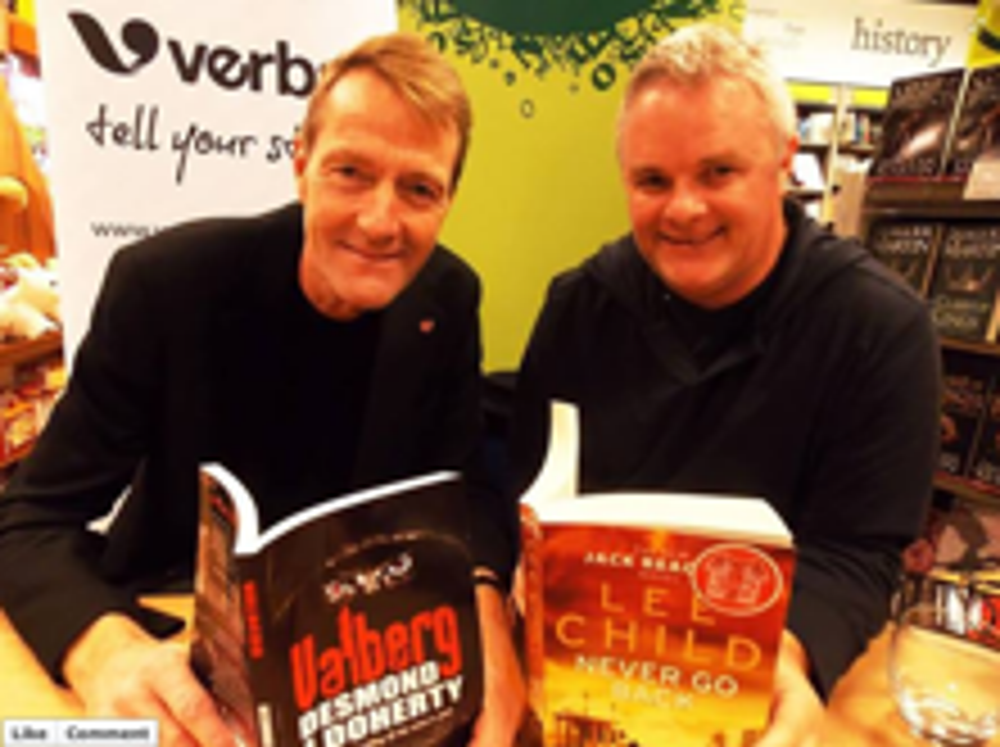
  Other than that, ‘Killer Books’ made for a very fine weekend indeed. As always, the best part of such events is meeting fellow scribes, such as Lee Child and Desmond Doherty (right and righter). I also had a couple of brief-but-lovely chats with Claire McGowan, Andrew Pepper, Stuart Neville, William Ryan, John McAllister, Arlene Hunt, Alan Glynn, Stephen Mearns and Ann Cleeves.
  On Friday afternoon I had the honour of taking part in a panel discussion on comedy crime fiction alongside Colin Bateman (who was a busy man, given that his ‘Teenage Kicks’ punk musical opened in Derry over the weekend) and Gerard Brennan, all of which was moderated in some style by the great Garbhan Downey.
  All told, ‘Killer Books’ was a huge credit to its curator, Brian McGilloway, who launched his latest offering, HURT, on the Friday evening. Here’s hoping that ‘Killer Books’ in Derry becomes an annual event …

Monday, March 18, 2013

Northern Lights

Colin Bateman and Eoin McNamee were two of the notable exceptions, but for many years Northern Ireland crime novelists steered clear of writing about ‘the Troubles’. Now a new generation of crime writers has begun to engage with that historical period and its violence, among them Claire McGowan, Adrian McKinty, Brian McGilloway and Anthony Quinn. I had a feature on the subject published in the Irish Examiner last Saturday, which opened up like this:

“The riot had taken on a beauty of its own,” begins Adrian McKinty’s novel The Cold Cold Ground, outlining in those few spare words why so many Northern Irish authors have recently turned to writing about the Troubles.
  Published in 2011, the novel was the first of a new series by McKinty, which features a Catholic RUC policeman operating in Belfast in 1981. As the terrible beauty of the opening page’s chaos gives way to the violence surrounding the hunger strikes, and the story broadens out to detail the province-wide paranoia and social unrest, the bombings and the murders, you start to wonder why it has taken so long for Northern Irish crime writers to embrace the Troubles as a setting.
  “I think, ultimately, crime fiction works best as a vicarious experience of crime, with the sense that there will be justice in some form,” says Derry-born author Brian McGilloway. “For many years there was no need to experience it vicariously, as it was happening for real. More than that, though, the idea of justice was a ridiculous one when it so clearly wasn’t happening in real life.”
  McGilloway writes a series of detective novels featuring Inspector Ben Devlin, a Donegal-based Garda who liaises with his counterpart across the border in the PSNI. While the novels have always dealt with post-Troubles scenarios, last year’s offering, The Nameless Dead, found Devlin resurrecting a case from the 1970s.
  Claire McGowan’s debut novel, The Fall (2012), was set in London. Her second offering, The Lost, is set in her native Newry, and concerns itself with a pair of missing girls, whose disappearance mirrors that of two girls who vanished in 1985.
  “I always think about something Ian Rankin said years ago,” she says, “that there was very little northern Irish crime fiction because the pain and violence was all too recent. We weren’t ready then to fictionalise it. I’d imagine people felt worried about engaging too directly with the powerful interests in society. It’s something I still worry about now.”
  Anthony Quinn, whose debut Disappeared was published last year, agrees. “During the Troubles many of us walked a tightrope with the IRA at one end and the British Army and Loyalist paramilitaries at the other. You had to be careful about what you said and wrote. Words could kill. If you said the wrong thing, you might never be seen again. The phrase ‘and whatever you say, say nothing’ was a mantra for survival.”
  McKinty, meanwhile, believes that an entire generation was so traumatised by the experience of the Troubles that it was shocked into silence.
  “No one wants to talk about it in these terms,” he says, “but it’s my belief that the whole of society in Northern Ireland is suffering from post-traumatic stress disorder. A war that lasted 30 years and impacted every walk of life and is still rumbling away in the background is going to leave deep and painful scars.”
  There were crime novelists who explored the consequences of the conflict while the Troubles were ongoing – Colin Bateman and Eoin McNamee spring to mind, along with thriller writers such as Gerald Seymour and Jack Higgins – but in recent years a growing number of younger writers have begun to incorporate their experiences of growing up through the Troubles into their stories.
  “Now, I think, the Troubles can be considered with a degree of distance and can be explored with intelligence and insight rather than being exploited for sensationalist entertainment, which was the case with many of the Troubles books of that period,” suggests McGilloway. “I think that’s what made it off-limits for so long – the sense that you didn’t want to exploit real pain and suffering.”
  Time and distance has also allowed some writers to come to terms with the anomalies of living through what the Chinese proverb euphemistically describes as ‘interesting times’.
  “For my own part, Disappeared allowed me to shine a light upon some deep contradictions in my own experience of the Troubles,” says Quinn. “My family were held at gunpoint by the IRA and our car hijacked in a murder bid on a policeman. We suffered intimidation and abuse. For instance, we were given a bullet by the IRA which was destined for my father if he contacted the police before a certain time. We were cowed into silence. Writing the book allowed me the chance to break this silence as well as explore the contradictory sense of being terrorised by the IRA and at the same time protected and somehow energised by them.”
  Claire McGowan also sees fiction as a means of giving voice to her conflicted childhood.
  “It’s a way of dealing with the past, and showing the wider world how things were for us,” she says. “I was born in 1981 and grew up through some very bad years, and I always struggle to explain to non-Irish friends what it was really like, how frightened we often were as children.”
  “The conspiracy of silence about the Troubles is what attracted me to writing about it in the first place,” says McKinty. “If you’re a writer and you take your job seriously you should be exploring regions that no one wants you to go into. You should be diving deep into the fractures and seeing what it was that made people act that way.”
  It’s possible for writers to play their part in a kind of reconciliation process, argues McGowan, by acknowledging that contemporary Northern Ireland is a compelling setting, and embracing its potential rather than ignoring its past.
  “For me it’s the aspect of living in a post-conflict society, where appalling events are still so fresh in the mind,” she says, “but we’re all supposed to wipe the slate clean and live alongside the perpetrators. What’s most amazing is how many people are willing to do this for the sake of peace.”
  “Even now, post-ceasefire, Northern Ireland is still a place in turmoil, emotionally and politically, as the Union Jack protests demonstrate,” says Quinn. “Swift political changes and inverted values have driven former terrorists into power, and to have this as a backdrop adds great dramatic tension and resonance to your writing, especially when you set individuals on a personal struggle between good and bad.”
  McGilloway also believes the crime novel has an important part to play in the cultural future of Northern Ireland.
  “Fiction has always provided a way to reflect on the concerns of society, and to allow the writer to tease out various scenarios,” he says. “I think the distance that the Peace Process has provided has allowed that to happen much more successfully. There’s a case of not being able to see the wood for the trees when you’re in the centre of things.”
  For Anthony Quinn, writing about the Troubles also provides a perspective on the present that isn’t necessarily politically correct.
  “One of the consequences of breaking this silence and writing about the Troubles,” he says, “and in particular the post-ceasefire society of Northern Ireland, is that it exposes the cracks in the harmonious, peaceful new society dreamed of in the Good Friday Agreement. But I believe Irish readers are now better able to tolerate these flaws.
  “Our politicians lie and dissemble,” he adds, “and historical documents can be subjective and flawed, but at least fiction never pretends to be anything else.”
  For writers, and artists of every kind, there is the not inconsiderable challenge of overcoming the historic resistance to Troubles-set drama.
  “The Troubles are an unpopular topic,” acknowledges McKinty, “but the events of the Troubles are so dark and heroic and perverse and mundane that to me at least they’re almost irresistible. It’s true that my book sales are a tiny fraction of other writers who wisely steer clear of these messy waters but I do think this period needs to be looked at by poets and novelists and film makers. Eventually the public will come round to seeing that too.”

  This feature was first published in the Irish Examiner.

Tuesday, July 3, 2012

ABSOLUTE ZERO COOL: Vote Early, Vote Often*

One of the great things about blogging is the opportunities it creates for cross-pollination and good karma and all that class of malarkey. Last Thursday, for example, I blogged about Gerard Cappa’s debut novel, BLOOD FROM A SHADOW, and noted that it was one of a significant number of Irish crime writing debuts in 2012. Gerard was kind enough to get in touch, to say thanks, but he didn’t let it rest there: the next thing I knew, Gerard had nominated ABSOLUTE ZERO COOL for a GoodReads reading group, which was kindness above and beyond the call of duty.
  Anyway, the voting is now open on that GoodReads reading group, as they vote to decide on what they’ll be reading in July and August. If you’re a member of GoodReads, and you’ve read AZC and think it might be worth their time and effort, your vote would be most welcome here …
  And thanks very much, Mr Gerard Cappa.
  In related news, Claire McGowan - author of another debut title this year, THE FALL - was generous enough to review AZC over at her Pains, Trains and Inkstains blog, with the gist running thusly:
“It’s beautifully written and very funny in parts, stuffed with wisdom and acerbic wit. I will definitely read his other novels, hoping to admire more smooth and cutting sentences, barbed jokes like thorns around some real naked pain. It has a great twist ending, and the title is - well - absolutely cool.” - Claire McGowan, author of THE FALL
  I thank you kindly, ma’am. By the way, if you’re new to this AZC thing and you’re wondering what all the fuss is about, there are signed copies cluttering up the shelves at the Liberties Press offices, and they’d only love to get rid of them. To help them out, clickety-click here …

  *Vote early, by all means, but only once. CAP Towers can in no way countenance subverting the democratic process.

Saturday, June 30, 2012

A Critical Juncture

Another day, yet another Irish crime writing debutant. CRITICAL VALUE by DC Gogan comes to my attention via the good works of Bryan Roche over at the Irish Crime Writing Facebook page, with the blurb elves wittering thusly:
A research project on homicidal fantasies ...
A murdered woman in the largest university in Ireland ...
Does a psychology student’s thesis hold the key to catching a killer?

Adam Twohig is in his final year of Psychology at University College Dublin. He never settled into the college lifestyle, never plugged into the social scene, and never excelled at his studies. Which is why he’s puzzled when Greg Taylor comes to him looking for help with his thesis.

Greg is studying the homicidal fantasies of UCD students, getting hundreds of written accounts of students’ darkest, murderous desires. When high-profile Entertainments Officer Christine Harvey is savagely murdered, the investigating detective wants access to his data. At first Adam thinks that the police are clutching at straws, but another murder on campus draws him deeper into the investigation.

The secrets buried in Greg’s data force Adam into an unlikely alliance between the Irish police and two FBI agents on the hunt for a serial killer, and put him and his friends in the sights of a murderer whose depravity seems to stand outside everything Adam knows about human psychology.
  Sounds intriguing, not least because it’s been quite a while - when Cormac Millar last deigned to grace us with his presence, basically - since we’ve had a good old-fashioned campus novel.
  What’s most interesting to me, though, is that it’s still only June and I’ve already seen or heard of eleven - now twelve - Irish crime writing debuts. Some are traditionally published, others are e-book only, one - Seamus Scanlon’s - is a collection of short stories; but regardless of format or form, 2012 marks something significant in the development of the Irish crime novel.
  To the best of my knowledge, the list of Irish crime debutants in 2012 runs as follows:
A JUNE OF ORDINARY MURDERS by Conor Brady;
BLOOD FROM A SHADOW by Gerard Cappa;
GHOST TOWN by Michael Clifford;
EL NINO by Mick Donnellan;
CRITICAL VALUE by DC Gogan;
THE FALL by Claire McGowan;
EVEN FLOW by Darragh McManus;
BLOOD RED TURNS DOLLAR GREEN by Paul O'Brien;
THE ISTANBUL PUZZLE by Laurence O’Bryan;
RED RIBBONS by Louise Phillips;
DISAPPEARED by Anthony Quinn;
AS CLOSE AS YOU’LL EVER BE by Seamus Scanlon.
  If I’ve missed out on anyone, or if you have a novel on the way later in the year, please drop me a line and I’ll include you on the list.
  Meanwhile, Louise Phillips (crimescenewriter@gmail.com) is putting together a series of features on debutant Irish crime writers for the writing.ie site. If you’re a new Irish crime writer, why not drop over to writing.ie and introduce yourself? I’m sure she’d be delighted to hear from you.

Monday, May 14, 2012

A Blume By Any Other Name

The latest Irish Times ‘Crime Beat’ column was published on Saturday, featuring short reviews of the latest titles from Elmore Leonard, Claire McGowan, Barry Forshaw, Hesh Kestin and Lyndsay Faye. It also included THE NAMESAKE by Conor Fitzgerald. To wit:
Commissioner Alec Blume returns in Conor Fitzgerald’s third novel, THE NAMESAKE (Bloomsbury, £11.99), although the usual Rome setting quickly gives way to southern Italy as Blume investigates the murder of an apparently innocent man and discovers that the victim shares a name with a magistrate intent on prosecuting a high-ranking member of the Ndrangheta, or Calabrian mafia. As with Claire McGowan’s novel, THE NAMESAKE is as much an exploration of the social, cultural and political factors that led to the rise of the Ndrangheta as it is a conventional police procedural; indeed, the book has as much in common with a spy novel, as Blume joins an undercover agent as he penetrates the Calabrian heartland.
  Exquisitely written in a quietly elegant style, and dotted with nuggets of coal-black humour, THE NAMESAKE is a bold blend of genre conventions that confirms Fitzgerald’s growing reputation as an author whose novels comfortably straddle the increasingly fine line between crime and literary fiction.
  Elsewhere, over the last few days, Eilis O’Hanlon reviewed the debut offering from Michael Clifford, GHOST TOWN; and Eamon Delaney reviewed yet another debut Irish crime title, Conor Brady’s A JUNE OF ORDINARY MURDERS.

Tuesday, April 10, 2012

Philadelphia, Here We Come!

Yours truly had a piece published in the Irish Times yesterday about how the latest generation of Irish crime writers - including Claire McGowan (right), Eoin Colfer and Laurence O’Bryan - are increasingly turning to foreign settings for their novels, rather than set them here on the Emerald Isle. Is this a simple matter of where said novelists are based? A personal fascination with a particular location? Is it a commercially driven development made by author savvy enough to realise that Ireland just doesn’t cut it as ‘sexy’ enough as a location for crime fiction, or an inevitable reflection of our emigrant experience?
  I’m kind of hoping it’s not the last reason, given that my current tome is set here in Ireland, as is my tome-to-be. Then again, this is probably the first time the words ‘Declan Burke’ and ‘commercially savvy’ have appeared in the same sentence.
  Anyhoo, on with the piece, which opened a lot like this:
THEY’RE QUITE fond of Irish crime novels over at the LA Times. Eoin Colfer is better known for his young adult novels featuring Artemis Fowl, but it’s PLUGGED, his debut adult crime novel, that is currently shortlisted for the LA Times Crime/Mystery Book of the Year.
  In 2011, two of that category’s five shortlisted novels were written by Irish authors, Tana French and Stuart Neville; in 2010, Neville won the award for his debut novel, THE TWELVE.
  In a nutshell, those LA Times nominations reflect the wider popularity and critical acclaim Irish crime writers are receiving in the US. John Connolly and Ken Bruen blazed a trail that was followed by French and Neville, Alan Glynn, Alex Barclay, Benjamin Black, Declan Hughes, Arlene Hunt, and more.
  They in turn paved the way for a new generation of Irish crime writers, one that differs from its forerunners in one crucial way: its reluctance to set its novels in Ireland.
Eoin Colfer’s PLUGGED, for example, is set in New Jersey.
  “Originally,” says Colfer, “PLUGGED was set in Dublin but it just never felt right to me, perhaps because noir novels are traditionally set in the US, or the fish I had created was not far enough out of water. When I moved it to New Jersey the whole thing clicked in my head and that’s about as much as I can explain it. It felt right. Daniel was an Irish guy out of his depth in America. As his adopted countrymen might say, it had the right vibe.”
  For the rest, clickety-click here …

Tuesday, February 7, 2012

Claire For Take-Off

Claire McGowan publishes her debut novel THE FALL this week, with the official launch - according to William Ryan over at the Irish Crime Writing Facepage - taking place at 6pm on Wednesday evening (February 8th) at Goldsboro Books, 23 - 25 Cecil Court , London WC2N 4EZ. Herewith be the blurb elves:
Bad things never happen to Charlotte. She’s living the life she’s always wanted and about to marry wealthy banker, Dan. But Dan’s been hiding a secret, and the pressure is pushing him over the edge. After he’s arrested for the vicious killing of a nightclub owner, Charlotte’s future is shattered. Then she opens her door to Keisha, an angry and frustrated stranger with a story to tell. Convinced of Dan’s innocence, Charlotte must fight for him - even if it means destroying her perfect life. But what Keisha knows threatens everyone she loves, and puts her own life in danger. DC Matthew Hegarty is riding high on the success of Dan’s arrest. But he’s finding it difficult to ignore his growing doubts as well as the beautiful and vulnerable Charlotte. Can he really risk it all for what’s right? Three stories. One truth. They all need to brace themselves for the fall.
  Despite the fact that the novel is not, apparently, a story about how Mark E. Smith resorts to murder to get mainstream radio air-play, the early word on THE FALL is good - a certain Peter James, for one, is impressed: “One of the very best novels I’ve read in a long while ... astonishing, powerful and immensely satisfying.” - Peter James
  Oh, and in case you were wondering: yes, as seems to be the case with virtually all the ladies of Irish crime fiction, she’s gorgeous too. How do we hate thee, Claire McGowan? Let us count the ways …

Sunday, January 29, 2012

“Ya Wanna Do It Here Or Down The Station, Punk?”: Claire McGowan

Yep, it’s rubber-hose time, folks: a rapid-fire Q&A for those shifty-looking usual suspects ...

What crime novel would you most like to have written?
I just read Mo Hayder’s TOYKO and it blew me away, to the point that I set it aside and thought, ‘I wish I could write like that’. It was a gripping story, a brilliant evocation of a place, a fascinating character study, and a hugely moving and emotional read. I’m in awe.

What fictional character would you most like to have been?
Nobody in a crime novel, that’s for sure. Even if you’re not a murder victim you’ll most likely be horribly traumatised by something. Probably someone from a Jilly Cooper novel, dripping in champagne and perfume, a hugely talented rider / TV producer / opera singer, and ending up madly in love with a gorgeous film director / polo player / musician. Sometimes it’s nice to read an unreservedly happy ending.

Who do you read for guilty pleasures?
As you can see above, I’m a big fan of Jilly Cooper, when I want to read something gripping, heart-warming, and glamorous. I’ve re-read most of hers at least ten times. I don’t feel guilty about it though. I feel guiltier about buying Heat magazine instead of all my unread copies of the London Review of Books.

Most satisfying writing moment?
I think it’s when a new story starts to take shape in your mind, and you feel excited about working on it, heart racing, palms sweating. When I’m editing I sometimes dream about leaving the old boring book for a thrilling new one. But you have to try to work things out.

The best Irish crime novel is …?
I’ve heard it described loosely as one, so I’ll risk saying Roddy Doyle’s THE WOMAN WHO WALKED INTO DOORS. I like books that can make me cry, and that one did, a lot. I can still recite bits of it from memory and I read it years ago.

What Irish crime novel would make a great movie?
I just read Stuart Neville’s COLLUSION, and thought it would work very well as a film, especially the dramatic end scene. I’d love to see someone make a crime series set in Ireland. Surely it’s about time.

Worst / best thing about being a writer?
The best thing is working on something creative all day, and immersing yourself in a story. Oh, and being able to work in your pyjamas, of course. The worst thing is the insecurity of always wondering are you any good, will people like what you do, is someone reading your book right now and enjoying/not enjoying it, can you write another book that works, etc. You can talk to people about what you’re doing, but it doesn’t always help, so most of the time, you’re on your own.

The pitch for your next book is …?
My next book is about a woman whose life is turned upside down when her mother dies and she finds out who her father really is. As she learns that nothing in her apparently ordinary life is what it seems, she and her young daughter are thrown into terrible danger. It’s a psychological thriller with echoes of REBECCA and JANE EYRE.

Who are you reading right now?
An Irish writer, as it happens – William Ryan’s THE BLOODY MEADOW. So far it’s great- I could tell from page one I was in the hands of an expert.

God appears and says you can only write OR read. Which would it be?
These are hard questions, aren’t they? Can I get a note from my Mum so I don’t have to answer? If you insist, probably reading. It would be sad, but I know I’d never produce anything good if I just wrote in a vacuum.

The three best words to describe your own writing are …?
Unsettling. Emotional. Foreshadow-y (or a good word I learned today and plan to use more – ‘presageful’).

Claire McGowan’s debut novel The Fall is published by Headline.
Declan Burke has published a number of novels, the most recent of which is ABSOLUTE ZERO COOL. As a journalist and critic, he writes and broadcasts on books and film for a variety of media outlets, including the Irish Times, RTE, the Irish Examiner and the Sunday Independent. He has an unfortunate habit of speaking about himself in the third person. All views expressed here are his own and are very likely to be contrary.