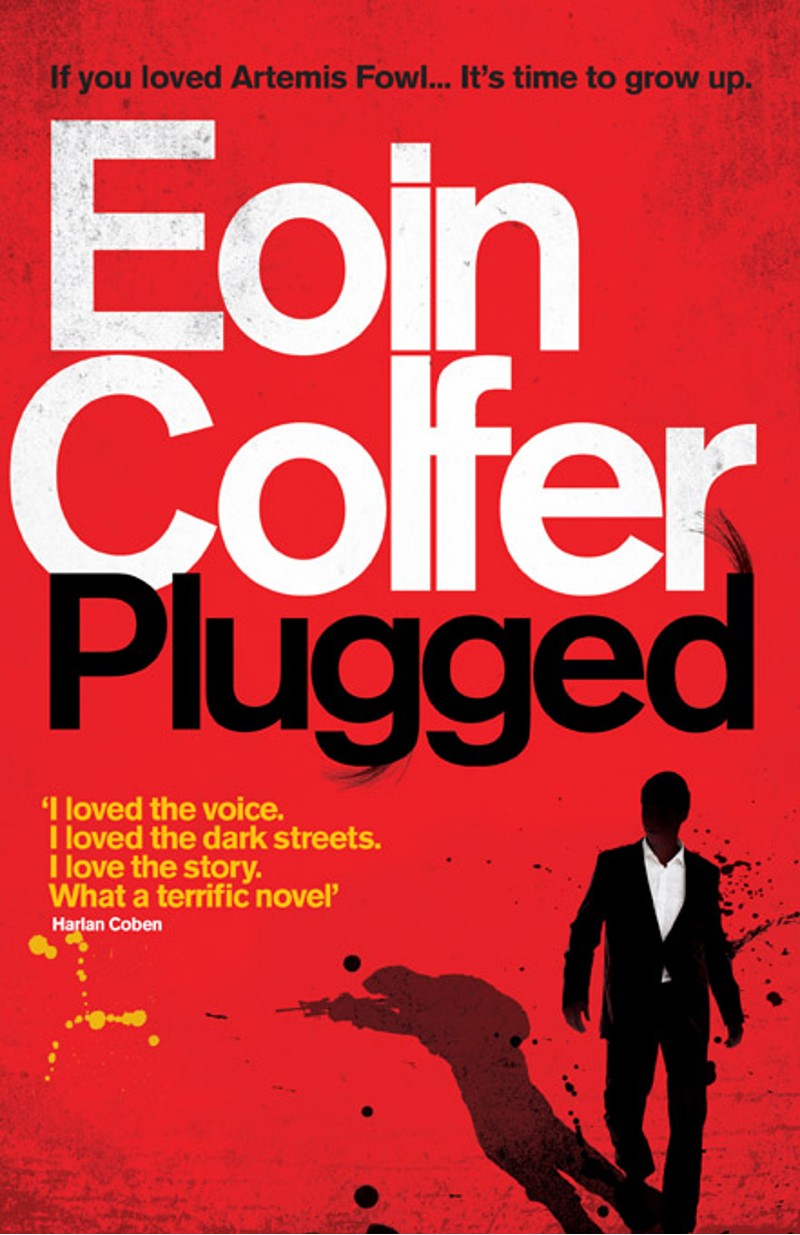
 I sat down with Eoin Colfer (right) last week, to interview him about his new novel, PLUGGED. The result reads a lot like this:
 “I started writing stories before I could actually write,” says Eoin Colfer. “Which sounds strange, but I would scribble on a blackboard, these nonsensical lines, and in my mind I was writing a story, I knew what the story was about.”
The adult Eoin Colfer is just as happy to let his imagination run riot. A phenomenal best-seller with his young adult Artemis Fowl novels, he turned last year to sci-fi, when he penned the latest instalment in the Hitchhiker’s Guide to the Galaxy. This year it’s adult crime fiction. PLUGGED is a comedy caper featuring an ex-Irish Army man, Danny McEvoy, deranged by baldness and set loose on the unsuspecting suburbs of New Jersey.
Writers are advised to write about what they know, but Colfer presents himself in the Fitzwilliam Hotel with a full thatch of greying hair and a neatly trimmed beard, looking not unlike Al Pacino’s younger brother. The quietly spoken one, who doesn’t need to shout and beat his chest, who has nothing left to prove.
“I really wanted to write PLUGGED for myself,” he says, “because I’d been writing for kids for ten years. But also I wanted to prove - mostly to myself, but to my friends too - that I could write for adults. Because there is a stigma attached to kids’ books, people say to you, ‘When are you going to write a real book?’ That said,” he laughs, “there’s a stigma attached to crime writing too. But maybe not so much.”
Colfer has come a long way since the days when his children’s books were so successful that he decided to stop writing.
“It was a tough time,” he says. “My wife had stopped teaching to open a shop, which we put all our savings into, and she wasn’t taking any salary - there wasn’t any salary to take (laughs). And I was teaching, and in the evenings I was minding the baby, putting the baby to bed, and then I’d try to write for a few hours. My early books all went to number one in the charts but I was only earning a couple of hundred quid per book. So something had to go, and the only thing that could go was the writing.”
Cometh the hour, cometh the Fowl.
“Well, boys have always liked an anti-hero, but when I finished the first Artemis, I thought, ‘I’m going to be murdered for this.’ This guy is feeding his friends drink, he’s a thief, a bad guy, he shoots his dad at one point … Luckily, in modern children’s fiction, he was the only one of his kind. Since then, there have been quite a few like him, and I’ve even been sent a couple of them to blurb, which I think is funny. I think the best one was a blatant mixture of Artemis Fowl and Harry Potter, it was kind of a criminal genius academy, with magic (laughs). It was actually quite good.”
With a best-selling career in children’s books established, Colfer struck up an unlikely friendship with Ken Bruen, the hard-boiled laureate of Irish crime fiction. Bruen persuaded Colfer to contribute a short story to his collection of short stories, ‘Dublin Noir’, which was published in 2006.
“I was never able to read that story at any of my events,” he says, “because it was always kids attending, but I did one late-night cabaret in Wexford a year ago and I read that story, and everyone was howling with laughter. Right up to the first swear-word I didn’t know whether I was going to chicken out, but then the first one went down so well, and I enjoyed reaction that very much. But I knew I couldn’t sustain that kind of nutcase humour for a whole book, it would get wearying, so I toned it down for the novel.”
The result is PLUGGED. “I just wanted to go for it, cut loose. I’d been working with kids’ stories for ten years, and as a writer you want to show what you can do.”
The story started out as a straight revenge thriller, with Lee Marvin movies a reference point, but quickly took on comic aspects.
“I just find it difficult to write ‘straight’,” he says. “I think there’s an element of that kid in class who just can’t stand the silence, and bursts out laughing in the middle of a serious situation. I guess I don’t like it when I feel the reader might be reading something of mine and maybe getting fed up. So it’s a little bit of a lack of confidence, that you can’t just trust that your prose is going to hold up, that you have to throw in a few one-liners.
“I’m still determined that some day I will write a serious book, but I have tried a few times already and it hasn’t worked out, so I just go back to the jokes. But at the same time, I think that’s a valid style. As long as you have a good story, any style is fine.”
In PLUGGED, Colfer does play it straight with Dan McEvoy’s army experience.
“That’s the one thing I didn’t want to mess with,” he acknowledges, “because the Irish army’s experience in Lebanon is something we’re very proud of as a country. So I didn’t want to start dicking around with that.
 But I sat down with a friend of mine who served over there, Declan Denny, and he told me some very interesting stories. Just interesting things like how during the day they’d meet the Christian militia on the road, and swap biscuits for milk, that kind of thing. And then the guy would say to Declan, ‘Okay, thank you. I won’t shoot at you tonight. I shoot, but not at you.’ And that kind of living, that day-to-day lunacy, and how they actually get used to it while they’re there, it’s amazing. So I tried to be respectful of that.”
If PLUGGED lives up to sales expectations, we’ll be seeing Dan McEvoy again, very probably prowling the mean streets of Dublin.
“Obviously,” he says, “I could write Artemis Fowl books for the rest of my life, that’s where the money is. But without challenging myself, the books would just plummet in quality, I think.”
As for how PLUGGED will be received, Colfer’s own expectations are pragmatic.
“It’s not Shakespeare, y’know? But I’m not trying to be Shakespeare. I’m just trying to have fun with a crime novel. And I think if you’re a real fan of crime fiction, this book is for you.”
Eoin Colfer’s PLUGGED is published by Headline.
This interview was first published in the Evening Herald.

,+William+McGivern.jpg)


